Video transcript
Ask three Malaysian agencies to quote the very same website, and three very different numbers come back. Part one. The problem, three quotes, three very different numbers. Take one corporate website, ten to fifteen pages. A budget studio quotes about RM 5,000. A mid range agency, around RM 12,000. A premium agency, up to RM 25,000. Same pages, same goal.
The quotes can sit a multiple apart. Price first tracks the project. A one to five page campaign site can run from about RM 1,500. A ten to fifteen page corporate site sits higher. A listed company site sits higher again. An online store, higher still. But even inside one project type, the range stays wide. Part two.
The answer, the width of the range is scope. That width is scope. Four levers move the price the most. Whether content writing is included, or left to you. Whether the design is custom, or built from a template. Whether post launch support is zero months, or three to twelve. And whether hosting and security are bundled in, or sold on the side. Every line in a quote is real work.
So ask for the quote line by line. Content, design, development, assets, security, analytics, and support, each one priced on its own. A low quote often quietly drops these, and adding them back raises the total. Scope also sets the calendar. A landing page takes two to four weeks. A standard corporate site, six to eight. A custom bilingual site, ten to fourteen. An online store, six to twelve.
And content delay is the single most common reason a six week build becomes a twelve week one. Part three. The takeaway, start with a brief, then compare line by line. The safe move starts before any quote. It starts with a brief. A clear brief pins the work down. Goals and audience, scope and sitemap, the content plan, features and technical needs, budget and timeline, and who signs off. Thirteen sections in all, written once, and sent to every agency.
So do not weigh three lump sums against each other. Weigh three itemised quotes against one itemised brief. That is how you see what you are really paying for, before you sign.
A Malaysian marketing director asks three Klang Valley agencies to quote on the same 12-page corporate brief. The three quotes can land in very different price bands, sometimes a multiple apart, even though all three describe a “professional, mobile-friendly WordPress site.” None of them are usually lying.
The gap tends to sit in what each agency is quietly including, quietly excluding, and where its team sits on the freelancer-to-enterprise spectrum. A low quote often excludes content writing, onsite SEO setup, SSL, analytics, and post-launch support; add those back and the total often rises sharply. A high quote often bundles bilingual content writing, photography, custom UI/UX, security hardening, and several months of maintenance. The middle quote can be the most honest of the three, but only an itemised breakdown will tell you why.
I am Lee Xin Ying, Account Director (Brand & Marketing) at Walk Production. Since 2018, my team in Kuala Lumpur and Selangor has scoped websites for Malaysian SMEs, MNCs, regulated firms, Bursa-listed groups, and B2B exporters. The buyer-side mistakes I see most often are reading prices in isolation, underestimating content, and skipping the brief.
This is the buyer-side hub for Malaysian web design, alongside our technical-execution anchors on website maintenance and landing page testing. It covers what a Malaysian website costs in 2026, the seven workstreams that explain why two quotes for the same brief land at very different totals, the 6-phase build timeline, the brief sections that protect your schedule, freelancer-versus-agency maths, technology choices (WordPress, custom, Webflow, Shopify), when to redesign and how to protect Google rankings through migration, the questions that surface real differences between agencies, and the regulatory baseline (PDPA, hosting, SSL).
That itemised-quote habit comes from how Walk Production is built: an integrated creative agency in Kuala Lumpur and Selangor, founded in 2018 by Evans Hu, running 40 in-house specialists across brand, design, copywriting, web, video, and digital under one roof. The 16 portfolio engagements behind this guide span B2B SaaS, industrial automation, healthcare, listed property, scientific instruments, and cloud services.
Why Malaysian web design quotes can vary tenfold
The single biggest variable in a Malaysian web design quote is not page count or visual ambition. It is scope of inclusion. In our agency experience, two quotes for the same brief can land in very different price bands because the lower one excludes content writing, photography, onsite SEO setup, SSL, hosting, and post-launch support. Add those back as separate line items and the gap can close, sometimes reversing.
The pattern shows up across every scope band. A starter SME asking for a 5-page brochure site tends to see freelancer and agency quotes a multiple apart. A Bursa-listed property group asking for a 25-page revamp with investor relations, bilingual content, and multilingual SEO tends to see an even wider gap. Four scope levers move price the most: content writing (included or excluded), custom UI/UX versus template-led layout, post-launch support (0 months versus 3 to 12 months), and hosting/SSL/security/maintenance (bundled or sold separately).
Asking every shortlisted agency to itemise the same brief is the cleanest way to compare. If a quote is a single lump sum, request a breakdown before comparing.
Web design cost bands in Malaysia
The ranges below are Walk Production agency planning bands drawn from our own quoting history and our observation of competitor proposals during shortlists. They are not a published market dataset or a structured survey. Treat each band as an indicative envelope for planning, not a quote. Actual fees vary widely with scope, sector, page complexity, custom features, content scope, photography, and bilingual or trilingual requirements. Always ask every shortlisted agency to itemise the same brief on the same line items before comparing.
Starter and campaign sites (1 to 5 pages)
| Tier | Market band (RM) | What you get | Timeline |
|---|---|---|---|
| Budget | 1,500 to 5,000 | Template, basic contact form, client-provided content, no SEO setup, no support | 1 to 3 weeks |
| Mid-range | 3,000 to 8,000 | Semi-custom design, conversion-focused layout, light SEO, basic analytics | 2 to 4 weeks |
| Premium | 6,000 to 12,000 | Fully custom UI/UX, A/B testing, analytics, agency content writing | 3 to 5 weeks |
Starter sites are conversion-focused pages built around a single objective: product launch, event registration, lead capture, or campaign. For execution detail on conversion patterns, our landing page testing guide is the technical-execution companion to this band.
Corporate websites (10 to 15 pages)
| Tier | Market band (RM) | What you get | Timeline |
|---|---|---|---|
| Budget | 5,000 to 9,000 | Template-led design, client-provided content, basic features, minimal SEO | 4 to 6 weeks |
| Mid-range | 8,500 to 15,000 | Custom UI/UX, professional copywriting, SEO setup, analytics, 3 months support | 6 to 8 weeks |
| Premium | 15,000 to 25,000 | Fully custom design, photography sourcing, bilingual content, advanced SEO | 6 to 10 weeks |
The 10 to 15 page corporate band is the most common scope for Malaysian SMEs. Homepage, About, Services (3 to 5 pages), Portfolio or Projects, Team, Contact, and a Blog hub is the typical structure.
Listed-company and MNC websites (20 to 30 pages)
| Tier | Market band (RM) | What you get | Timeline |
|---|---|---|---|
| Standard | 18,000 to 30,000 | Custom UI/UX, professional copywriting, investor relations section, SEO setup | 8 to 12 weeks |
| Premium | 30,000 to 45,000 | Fully custom design, bilingual EN/BM, photography, IR templates, performance tuning | 10 to 14 weeks |
| Enterprise | 45,000 to 60,000 | Trilingual EN/BM/CN, multi-stakeholder IA, CMS for non-technical IR team, integrations | 12 to 16 weeks |
Listed-company websites carry investor relations expectations: an investor landing page, annual reports archive, financial highlights, corporate governance, board composition, and a timely announcements feed. Bursa Securities and SC disclosure expectations shape the IA. Where the build connects to an annual report cycle, the annual report design anchor covers the report-side companion.
E-commerce websites
| Tier | Market band (RM) | What you get | Timeline |
|---|---|---|---|
| Budget | 6,000 to 15,000 | WooCommerce or Shopify template, basic product catalogue, single payment gateway | 4 to 6 weeks |
| Mid-range | 15,000 to 35,000 | Custom storefront, FPX + GrabPay + Touch ‘n Go integration, inventory, basic CRM | 8 to 12 weeks |
| Premium | 35,000 to 60,000 | Fully custom build, multi-channel, advanced CRM, ERP integration, multilingual | 12 to 16 weeks |
E-commerce sites need payment gateway integration (FPX, iPay88, GrabPay, Touch ‘n Go eWallet, Boost), inventory management, cart functionality, and shipping calculation. They carry higher ongoing maintenance costs than corporate sites. Walk Production primarily focuses on corporate websites, landing pages, microsites, and event sites; for high-volume e-commerce, a Shopify specialist is usually the right partner.
A per-page reference, as a rough cross-check
A basic template page typically runs RM 500 to RM 800. A custom-designed page with unique layout and content sits at RM 1,000 to RM 1,500. A complex page with interactive elements, custom illustrations, or data visualisation runs RM 1,500 to RM 2,500. Per-page maths is a sanity check on totals, not a quote method. A 15-page site with three unique templates costs less than a 15-page site with twelve unique templates.
The seven workstreams that drive website cost
A website project contains seven distinct workstreams that each contribute to the final number. Understanding them is what lets you compare quotes line-by-line.
1. Content strategy and copywriting
Most clients assume they will provide their own content. In practice, most underestimate how much writing a corporate website demands. A 15-page site needs a homepage, About, three to five service pages, team profiles, project or portfolio descriptions, a contact page, and meta descriptions for every page. Professional web copywriting is written for human readers and search engines together.
Content delay is the single most common reason a 6-week build becomes a 12-week one. Agencies that include content writing factor it into the quote; those that exclude it hand you a design with placeholder text and a separate content problem to solve. Walk Production includes professional web copywriting in all three packages (WebCore, WebHost, WebGrowth).
2. UI/UX design
Wireframes, visual mockups, responsive layouts. Complexity scales with the number of unique page templates and whether mobile-first layout has been thought through. A 20-page site with 3 unique templates costs less than a 20-page site with 12.
3. WordPress (or framework) development
For most Malaysian corporate sites we scope, development means WordPress with Elementor Pro or Custom Website Development, a custom-coded build on a framework such as Astro. Scope covers responsive coding, contact form integration, third-party tool connections, CMS configuration, onsite SEO setup, and GA4 and Search Console integration. A custom-coded build typically adds 1 to 2 weeks to the development phase.
4. Graphic assets and photography
Icons, illustrations, infographics, image sourcing, stock photography licensing. Authentic team and office photography lifts trust signals more than stock imagery. Some agencies include graphic design for web as standard; others quote it as an add-on.
5. Security and performance setup
SSL certificates (HTTPS is the modern baseline; browsers flag sites without a valid certificate, and HTTPS is a confirmed Google ranking signal), WordPress security hardening, login attempt limits, two-factor authentication on admin, bot protection, spam filtering, caching, image compression. The website maintenance anchor covers the operational side.
6. Analytics and tracking
Google Analytics 4, Search Console, Tag Manager, Meta Pixel, conversion tracking. Current GA4 attribution options are data-driven and paid/organic last click; first-click, linear, time-decay, and position-based models were retired in November 2023 (Google Analytics Help). Configure tracking during development.
7. Post-launch support, hosting, and maintenance
Some agencies consider their work complete at launch. Others bundle 3 to 6 months of complimentary support for adjustments, bug fixes, and CMS training. Hosting and maintenance retainers (core/plugin updates, security monitoring) compound year-on-year. Walk Production’s WebHost package includes 3 months of complimentary post-launch support; WebGrowth adds the WebCare maintenance subscription on top.
How long a Malaysian website takes, by project type
Timelines depend on scope, content readiness, approver structure, and how cleanly the kickoff brief locks the scope. The ranges below assume timely client feedback (48 to 72 hour turnaround), a single internal approver, and a locked scope at kickoff.
| Project type | Realistic timeline | Page count |
|---|---|---|
| Landing page or campaign site | 2 to 4 weeks | 1 to 5 pages |
| Event site | 2 to 4 weeks | 5 to 10 pages |
| Microsite | 3 to 4 weeks | 5 to 15 pages |
| Corporate website (standard) | 6 to 8 weeks | 10 to 30 pages |
| Corporate website (custom, bilingual) | 10 to 14 weeks | 20 to 30 pages |
| E-commerce build | 6 to 12 weeks | varies |
Multilingual websites deserve a separate note. Adding a full BM translation alongside English tends to add 2 to 4 weeks for translation, localisation, and bilingual QA across every page. Adding Mandarin on top adds another 2 to 3 weeks. Our bilingual copywriting anchor covers the EN/BM/CN cost uplift in detail (1.6 to 1.8x of the English baseline is the rough planning multiplier we use).
The 6 phases of a Malaysian web design project
Every Walk Production website moves through the same 6-phase process with formal sign-off gates at each boundary:
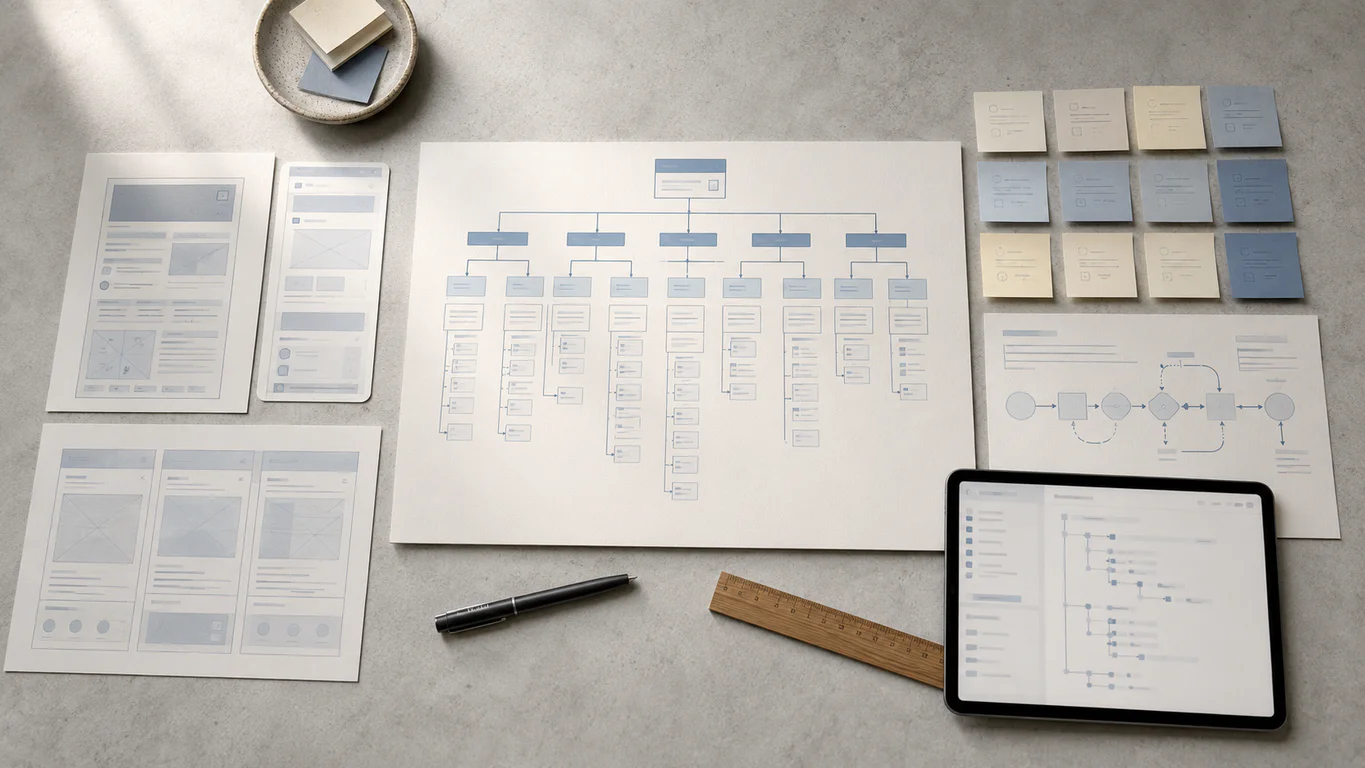
Phase 1: Discovery and planning (week 1). Stakeholder interviews, business goal alignment, audience identification, sitemap, content outline, project schedule. Most important output: a locked scope.
Phase 2: Content development (weeks 1 to 3). Page copy, meta descriptions, SEO-focused content, media plan. Runs partly in parallel with discovery. When the agency writes content in-house, this phase moves predictably; when the client supplies it, this is where most projects stall.
Phase 3: UI/UX design (weeks 3 to 4). Low-fidelity wireframes first; once approved, high-fidelity mockups with final colours, typography, imagery. The biggest risk here is subjective feedback from multiple approvers.
Phase 4: Website development (weeks 4 to 6). The approved designs are built into a staging environment, either on WordPress with Elementor Pro or as a custom-coded build. Responsive coding, contact forms, third-party integrations, CMS setup, performance work. Custom-coded builds typically add 1 to 2 weeks here.
Phase 5: Testing and launch (week 7). Cross-browser testing, mobile responsiveness on real devices, form validation, broken-link audits, page-experience checks, onsite SEO verification, 301 redirects for changed URLs, DNS migration, GA4 and Search Console configuration, handover documentation.
Phase 6: Post-launch support (months 2 to 4). CMS training, video guides, minor content adjustments, bug fixes. Walk Production includes 3 months of complimentary support in the WebHost and WebGrowth packages.
What delays a website project
The five causes below account for most corporate-build delays we see:
- Late content delivery. Treat content as a parallel workstream, or use an agency with in-house writers.
- Scope changes after design starts. Lock scope during discovery. Use a formal change-order process.
- Multiple approvers with conflicting feedback. Appoint one decision-maker. Agree a 48 to 72 hour turnaround per review.
- Unclear requirements surfacing in week 4. Document languages, integrations, compliance, IT-policy needs before design begins.
- Third-party dependencies. Domain credentials, CRM API keys, analytics access. Identify in week 1, gather in parallel.
A sixth factor specific to Malaysia: holiday clusters (Chinese New Year, Hari Raya, year-end). Build buffer into any schedule that crosses one.
Writing a website brief that does not slip the schedule
A working brief is not a wishlist. It is a contract-shaping document covering scope, audience, success metrics, content owner, technical constraints, and budget envelope. Briefs with the 13 sections below produce accurate quotes. Briefs with three of those sections produce six-week projects that turn into sixteen-week projects for entirely preventable reasons.
The 13 sections a working brief needs
- Company and project overview. Business background, why the project is happening now, existing brand work to align with.
- Objectives and success metrics. Lead generation, credibility, recruitment, sales, plus measurable indicators (form submissions/month, organic traffic, conversion thresholds).
- Target audience. Demographics, psychographics, device preference, language. Note any distinction between decision-makers and researchers.
- Competitor and reference sites. Five direct competitors, five aspirational references. Note what works and what does not.
- Current website audit (for redesigns). Analytics export: top pages, traffic sources, conversion rates, known UX issues.
- Scope and rough sitemap. Even a rough page list before design sets realistic timeline and cost expectations.
- Content plan. What exists, what migrates, what gets written from scratch. Decide who writes.
- Brand and visual style. Vector logo files, colour codes, typography rules, reference sites, hard constraints.
- Functionality requirements. Must-have versus nice-to-have. Forms, blog, CRM integration, multilingual, analytics, booking.
- Technical requirements. Preferred CMS, hosting, performance, security, browser/device support, SEO redirects, PDPA, IT-policy constraints.
- Budget range. Agencies do not need an exact figure; knowing whether it is RM 8,500 or RM 35,000 determines scope.
- Timeline and deadlines. Desired launch date, hard deadlines tied to product launches, events, or grant disbursements.
- Stakeholders and approvers. Primary contact, final decision-maker, reviewers. Define the approval process per phase.
Freelancer vs agency: the build-versus-buy maths
The freelancer-versus-agency question is not about which model is automatically better. It is about which model fits the project complexity, the risk the business can absorb, and what happens after launch. Both can produce excellent work for the right scope. Both can fail for the wrong one.
Headline rates
| Project type | Freelancer (RM) | Agency (RM) |
|---|---|---|
| Basic website, 1 to 5 pages | 1,000 to 4,000 | 3,000 to 8,000 |
| Corporate website, 10 to 15 pages | 4,000 to 10,000 | 8,500 to 18,000 |
| Corporate website, premium or custom | not the right fit | 18,000 to 60,000 |
| Hourly rate | 50 to 350 | covered by project fee |
Freelancer pricing generally does not include hosting, maintenance, content writing, SEO setup, or ongoing support. Agencies typically bundle these into their packages with one project manager coordinating designers, developers, copywriters, and SEO specialists.
The five risks of hiring a freelancer
The freelancer model carries five structural risks worth pricing into the decision:
- Project abandonment. Solo operators may take a full-time job, fall ill, or get overwhelmed. When they drop out, your project stops.
- Limited skill coverage. Most freelancers specialise in one discipline. A WordPress developer may miss performance issues, accessibility gaps, or SEO fundamentals.
- No internal quality checks. Agencies run internal reviews before deliverables reach the client. Freelancers skip this; you become the QA team.
- Scope creep without controls. Small requests snowball without formal change management. Agencies define revision rounds and log change requests with their impact.
- Ownership and dependency. Some freelancers register your domain or hosting under their own accounts. Always confirm in writing that you own the domain, hosting credentials, and source files.
Which model fits which project
A skilled freelancer can produce excellent work for a 1 to 5 page site with a clear, locked scope, client-supplied content, limited integrations, and no SEO or analytics setup needed. Personal portfolios, simple brochure sites, and single-objective landing pages fit this band well.
A 10-page-plus corporate site with multiple stakeholders, multilingual content, custom UI/UX, SEO setup, and ongoing maintenance needs the structure of an agency. The team model reduces single-point-of-failure risk, runs disciplines in parallel, and offers a defined post-launch support arrangement.
The honest cost gap: freelancers tend to come in cheaper on the headline number, but the gap narrows once year-one overheads are added back to the freelancer total (content writing, SSL, hosting, security setup, onsite SEO, analytics, post-launch fixes). A RM 4,000 freelancer quote that becomes a RM 8,000 total once the missing line items are commissioned separately is no longer materially cheaper than a RM 9,000 agency quote that bundled them in from the start.
WordPress, custom, Webflow, Shopify: choosing the technology
The platform shapes long-term flexibility, maintenance costs, and your team’s ability to manage content independently. The four platforms below account for almost every Malaysian corporate website built today.
WordPress
WordPress powers over 40 per cent of websites globally per W3Techs and remains a common choice for Malaysian corporate websites. The open-source model means you own your site outright; unlike proprietary builders, a WordPress site can move between hosting providers without rebuilding.
What works:
- Broad plugin network (WordPress.org features) for forms, SEO, caching, multilingual content
- Wide Malaysian developer pool, which tends to keep maintenance pricing competitive
- Strong SEO foundation: customisable permalinks, heading hierarchy, image alt text, schema markup support
- Elementor Pro provides visual editing for the client team while maintaining clean code output
- Multilingual support through WPML or Polylang for EN/BM/CN sites
What to watch:
- Plugin dependency can create bloat. A typical corporate site might run 15 to 25 plugins, and each one adds code the server executes on every page load. Disciplined plugin selection matters.
- Because WordPress is widely used, it attracts automated attack traffic. Security hardening (strong passwords, 2FA, login attempt limits, bot protection) and regular core/plugin updates are non-negotiable.
- Core releases several times a year; themes and plugins release more often. A structured maintenance plan covers this.
Walk Production offers WordPress with Elementor Pro as one of its two development routes. The wide Malaysian developer pool is the practical reason: maintenance stays straightforward to resource for years after launch.
Custom builds (Astro, Next.js, Laravel, React)
Custom-coded builds now cover two different jobs, and it pays to keep them apart. The first is the corporate website built as custom code on a framework such as Astro. Pages are pre-built and served as static files, so there is no plugin stack to patch and very little ongoing maintenance. This route suits company sites where the ongoing work is content updates rather than weekly layout rebuilds, and it typically takes 1 to 2 weeks longer than the equivalent WordPress build. Walk Production offers this as Custom Website Development alongside WordPress, with the recommendation made at proposal stage based on the brief.
The second job is the true web application: live dashboards, booking engines with concurrency, real-time data processing. That is heavier work on frameworks such as Next.js or Laravel. Build costs sit materially above a corporate website, and maintenance depends on the development team behind it.
Webflow, Wix, and Shopify
Webflow is design-led and works well for portfolio-style sites where the visual experience matters more than CMS flexibility. Wix and Squarespace are proprietary builders that work for personal sites or small portfolios but offer limited control over code, SEO configuration, and data portability. You cannot easily move a Wix site to a different host. Shopify is purpose-built for e-commerce: if your primary need is an online store with payment processing and inventory management, Shopify is often more efficient than WooCommerce. For corporate sites that combine service pages, portfolio, and blog content, WordPress handles the same scope inside one platform.
A quick comparison
| Platform | Best for | Typical Walk Production cost band (RM) |
|---|---|---|
| WordPress + Elementor Pro | Corporate sites where the client team edits layouts, content-heavy publishers, multilingual | 8,000 to 45,000 |
| Custom Website Development (custom-coded build, e.g. Astro) | Corporate sites where routine updates are to content rather than layout, and where speed and low maintenance matter | 8,000 to 45,000 |
| Wix / Squarespace | Small businesses, single-product launches, personal sites | 3,000 to 12,000 (third-party) |
| Shopify | E-commerce stores | 12,000 to 50,000 (specialist) |
| Web application (Next.js / Laravel) | Live dashboards, booking engines, real-time data | 30,000 to 60,000 |
The cost bands above are Walk Production-anchored where we deliver in-house, third-party-anchored where we route to specialist partners (Wix, Shopify).
When to redesign and how to protect Google rankings
Most Malaysian businesses delay a redesign too long. The signals usually appear over 18 to 24 months: load times creep up, the homepage looks dated on mobile, the enquiry form fires twice a week instead of twice a day, and Search Console flags page-experience issues across the top 20 URLs. Every month of delay sends traffic to competitors whose sites meet current page-experience expectations.
Signs your website needs a redesign
- Outdated visual design. Layouts, fonts, or colour schemes from 2018 or earlier signal an outdated business, especially for corporate and professional services firms.
- Poor mobile experience. Pinching, zooming, or horizontal scrolling on a phone loses visitors. Google uses mobile-first indexing.
- Slow page load times. Run the site through Google PageSpeed Insights. A low mobile score is a strong signal that user experience is suffering and is one input among several Google considers as part of page experience.
- Low conversion rates. Traffic steady but conversions declining usually points to unclear CTAs, confusing layouts, or forms buried deep.
- Security vulnerabilities. Outdated CMS, expired SSL, unpatched plugins. PDPA adds responsibility on businesses handling customer data.
- CMS limitations. If the platform makes it difficult to add pages, update content, or integrate with GA4, the site has outgrown its CMS.
The six steps that protect your rankings through a redesign
The biggest risk in any redesign is losing the search rankings built over time. SEO migration is the set of technical steps that preserves organic traffic through the cutover. Skipping it can produce a sharp drop in visibility that takes months to recover. The six-step migration discipline:
- Crawl and document the current site. Use Google Search Console to export indexed URLs, top-traffic pages, and current keyword rankings. This is the baseline.
- Map old URLs to new URLs. Create a URL mapping spreadsheet. Every old URL gets a corresponding new URL.
- Implement 301 redirects. A 301 redirect tells search engines a page has permanently moved. Every changed URL needs one. Missing even a few high-traffic pages can produce significant ranking drops.
- Preserve on-page SEO elements. Carry over existing meta titles, meta descriptions, header tags, and image alt text for pages that rank well. Improving them is fine; discarding them and starting from scratch without good reason is not.
- Submit the updated sitemap. After launch, submit the new XML sitemap to Search Console. This prompts Google to crawl the new structure. Monitor the Index Coverage report for errors in the first weeks.
- Monitor for 30 days post-launch. Daily checks for crawl errors, 404 pages, and indexing issues. Some short-term fluctuation is normal. A sustained drop means something was missed and needs fixing fast.
Pairing the redesign with an SEO retainer reduces the risk further. Our link-building anchor covers the post-launch SEO baseline and our choose SEO agency anchor covers the retainer-side decision.
How to choose a web design agency in Malaysia
Most Malaysian boardrooms tilt toward the prettiest hero section in a pitch deck. The prettiest hero is rarely the most predictive signal of project success. The five criteria below surface more honest differences between firms.
1. Process and phases
Ask every shortlisted agency to describe the project from kickoff to launch. A reliable process includes the six phases above. If an agency starts designing before content is written, question how they handle content-design alignment. Websites built around placeholder text almost always need layout rework once the actual content arrives.
2. Team composition and in-house capability
Find out who will actually work on the project. Agencies that keep content writing, graphic design, UI/UX, and development under one roof offer a coordination advantage: the copywriter can adjust headline lengths with the designer in real time, the developer can flag technical constraints during design rather than after mockups are approved. A common Malaysian pattern is for an agency to handle design in-house and outsource development (or vice versa), which introduces handoff points where quality can slip.
Walk Production maintains 40 in-house specialists across eight integrated disciplines, with UI/UX, WordPress development, security and analytics all handled inside the web practice.
3. Portfolio depth and relevance
Strong homepage screenshots do not tell you whether inner pages are equally well designed, whether the mobile experience was considered, or whether content was written professionally. For each portfolio piece, ask: did the agency write the content or design around client-supplied text? Did they handle hosting and post-launch maintenance? Are the sites still live and performing on Google PageSpeed Insights today?
4. Pricing transparency and inclusions
When a quote arrives, check whether it covers content writing, photography, SEO setup, hosting, SSL, security hardening, analytics, and post-launch support, or quotes them as separate line items. The cheapest quote on the table at week 1 is almost never the cheapest build at month 12.
5. Post-launch support and ownership
A website needs ongoing attention after launch. WordPress core updates, plugin patches, security monitoring, content changes. Ask about maintenance plans, support response times, update procedures. Ask directly: do I own the domain, hosting credentials, design files, source code? Some agencies build on proprietary systems that only they can modify, giving them control over future updates and pricing. The contract should state ownership clearly before any deposit is paid.
Eight questions for the evaluation meeting
- What is your process from kickoff to launch?
- Do you write website content in-house, or is that my responsibility?
- What CMS do you use, and will I be able to manage content after launch?
- How many people will work on my project, and what are their roles?
- What does your post-launch support include, and for how long?
- Do you handle hosting, SSL, and security, or do I arrange those separately?
- Can you share references from clients in my sector or scope?
- What analytics and tracking do you configure at launch?
Red flags that predict a painful project
- No content strategy. Designing before discussing content plan is building a house without a floor plan.
- No staging environment. Developing on a live server means you cannot review before public launch.
- Vague timelines. Corporate sites should take 6 to 8 weeks; landing pages 2 to 4 weeks. If the agency cannot commit to a written schedule, that is a signal.
- Unrealistically low pricing. Very low quotes usually exclude critical services. Add them back and the total often exceeds a full agency quote.
- No post-launch plan. No support period, no maintenance offering, no hosting recommendation.
- Hidden platform lock-in. Proprietary systems only the original agency can modify. Ask directly whether you can move the site.
- Outdated portfolio work. Most recent work over two years old, or showcased sites lacking mobile responsiveness.
PDPA, hosting, and the Malaysian regulatory baseline
Every Malaysian business website that captures customer data sits under the Personal Data Protection Act 2010, recently amended by the Personal Data Protection (Amendment) Act 2024 (Act A1727). JPDP publishes guidance on Data Breach Notification and on Data Protection Officer obligations (see the JPDP FAQ on DPO thresholds). Confirm current rules and effective dates with JPDP or legal counsel before signing off.
The recurring PDPA implications for a business website tend to be:
- Privacy notice in English and Bahasa Malaysia, footer-accessible. Covers data collected, use, retention, data subject rights.
- Cookie consent. Cookies tracking beyond strict functional necessity should be deployed only after consent.
- Data breach notification to JPDP and affected data subjects within the guideline timeframe where the breach is likely to cause significant harm.
- Data Protection Officer. Businesses processing personal data above the threshold scope set out in the DPO guideline should appoint a DPO. Confirm with counsel.
SSL, HTTPS, hosting
HTTPS is non-negotiable in 2026. SSL certificate management is governed by the CA/Browser Forum Baseline Requirements. Walk Production includes SSL in WebHost and WebGrowth packages by default. Hosting choices affect latency and PDPA posture; most Malaysian corporate sites we scope run on Cloudflare-backed managed hosting (KL or Singapore data centres). The MCMC website is the source of record for the wider framework, with sector-specific rules (BNM for banks, SC for capital markets) on top for regulated industries.
Government grants for SME digitalisation
Malaysian SME digitalisation grants run on cycles; envelopes, eligibility, and matching ratios change. Always confirm current scope, ceilings, and timelines directly with the issuing agency before structuring a quotation around a grant. The two starting points to verify are SME Corp for SME digitalisation schemes and the Ministry of Digital for Budget 2026 digital allocations. MDEC administers sector programmes; note its Digital Content Grant is scoped to animation, digital games, digital comics, and creative-technology content production, not general SME website builds.
This is marketing guidance, not grant advice.
Three real Walk Production website engagements
The three engagements below sit at different points on the cost and complexity spectrum: a long-term B2B SaaS revamp, a trilingual SaaS platform rebuild, and a listed-company revamp with investor relations scope. Scope details are drawn from Walk Production’s project records.
1. Aegis Cloud: long-term B2B SaaS website + ongoing revamps
Aegis Cloud is a Malaysian cloud services provider specialising in backup, disaster recovery, managed cloud hosting, and data protection. The engagement covers the original corporate website build, a later revamp, and a long-running SEO retainer.
The original build established a clear B2B platform with dedicated service category pages for backup, disaster recovery, and managed hosting. The UI/UX approach focused on how B2B technology buyers research providers: clean navigation, logical groupings, direct paths to product information. A subsequent revamp modernised the visual presentation and expanded keyword targeting across additional service categories while maintaining the professional standards B2B clients expect.
The buyer-side lesson is that a website rarely earns its keep on the launch screenshot. Aegis Cloud has run a sustained SEO retainer alongside the website, with sustained keyword performance across the targeted set and a steady inbound pipeline of qualified enquiries. The website is a working sales asset, not a brochure.
Walk Production cost band (corporate website + ongoing SEO retainer): the build sits in the corporate mid-tier band, with the SEO retainer running separately on a monthly basis.
2. Kakitangan.com: trilingual SaaS website revamp
Kakitangan.com is a Malaysian HR software platform offering payroll, attendance, and HR administration. The revamp covered UI/UX design, custom illustrations, multilingual content writing in English, Mandarin, and Bahasa Malaysia, website development, blog management, and SEO.
The UI/UX used a vibrant colour palette to convey professional friendliness while maintaining the credibility B2B SaaS buyers expect. Navigation was structured around the key actions visitors take when evaluating HR platforms: feature comparison, pricing review, demo requests. A custom illustration library representing diverse professional sectors and ethnic backgrounds replaced generic stock imagery and gives Kakitangan a distinctive visual identity.
Each language version received original copy rather than direct translation. The B2B SEO retainer targeted commercial keywords related to online payroll systems and HR software in Malaysia, with on-page optimisation aligned to employer search terms across the three language segments. A regular blog publishing schedule builds topical authority and supports main service pages through internal linking.
The buyer-side lesson is that multilingual websites are not translated websites. Each language version is an original content investment. On the trilingual builds we run, the EN/BM/CN content uplift adds roughly 1.6 to 1.8x the English baseline and 2 to 3 weeks to the build timeline. Both should be costed in from the start.
Walk Production cost band (trilingual corporate website revamp + ongoing blog and SEO): premium tier of the corporate band with the multilingual uplift applied.
3. MGB Berhad: Bursa-listed property and construction revamp
MGB Berhad is a Bursa-listed company in the construction and property development sector. The revamp covered UI/UX design, website development, web content writing, website maintenance, and managed hosting.
As a listed entity, MGB Berhad’s website serves multiple stakeholder groups at once: shareholders, institutional investors, business partners, media contacts, and commercial clients. The UI/UX strategy focused on information accessibility across these audiences. Clean, grid-based layouts present corporate information without visual clutter; navigation organises content into clear sections for investors, potential clients, media, and corporate partners.
The structured investor relations section organises annual reports, quarterly results, material announcements, and board composition details with clear categorisation and chronological filing. Corporate web copy communicates the company’s direction in language suited to investor and business audiences. The modular WordPress design system allows the internal team to publish announcements, update project statuses, and add new financial documents without developer support. Ongoing maintenance and managed hosting cover performance monitoring, security updates, SSL management, and regular backups.
The buyer-side lesson is that listed-company websites carry IA complexity that smaller corporate sites do not. Investor relations, governance, announcements, and disclosure scope add page count and CMS workflow requirements. The build typically lands in the premium corporate band, sometimes the enterprise band, depending on bilingual scope and IR integrations.
Walk Production cost band (listed-company website revamp + maintenance + managed hosting): premium tier of the corporate band, with maintenance running as a monthly subscription on top.
Hidden costs and the three-year total
The initial build is part of the total. The annual recurring expenses below tend to be where year-one budgets overrun.
Annual recurring expenses
- Domain registration. RM 60 to RM 200 per year depending on the extension (.com, .my, .com.my). A .com.my domain is a Malaysia-specific locale signal for users and search engines (see Google’s managing multi-regional sites guidance); registration runs through MYNIC accredited resellers.
- Cloud hosting. RM 500 to RM 3,000 per year for managed WordPress hosting with SSL, backups, and performance optimisation. Higher-tier managed hosting for high-traffic listed-company or e-commerce sites runs more, typically RM 3,000 to RM 12,000 per year.
- Maintenance and updates. RM 6,000 to RM 12,000 per year for WordPress core updates, plugin updates, security monitoring, performance checks, and content changes. Walk Production’s WebCare maintenance covers this scope.
- Premium plugin licences. RM 500 to RM 2,500 per year for tools like Elementor Pro, SEO plugins (Yoast, Rank Math), backup services (UpdraftPlus), and multilingual plugins (WPML, Polylang).
- Professional email. Google Workspace or Microsoft 365 is separate from website hosting. RM 30 to RM 100 per user per month, depending on tier.
A realistic three-year total
| Business stage | Initial build (RM) | Annual ongoing (RM) | 3-year total (RM) |
|---|---|---|---|
| Starter or basic presence | 5,000 to 12,000 | 2,500 to 5,000 | 12,500 to 27,000 |
| Standard corporate site | 12,000 to 25,000 | 5,000 to 10,000 | 27,000 to 55,000 |
| Premium corporate or listed | 25,000 to 60,000 | 8,000 to 12,000 | 49,000 to 96,000 |
These ranges include the build, hosting, domain, maintenance, and plugin renewals. They do not include SEO retainers, content marketing retainers, paid media spend, or major feature additions, which are typically scoped separately. Planning one-fifth to one-half of the initial build cost as the annual ongoing envelope produces realistic year-one numbers, with the lower end applying to premium builds and the higher end to starter sites.
Common mistakes that turn a six-week build into a sixteen-week one
The six mistakes below cover most of what we see when a Malaysian business engages Walk Production for a fresh website project. None are sector-specific. All are preventable.
Underestimating content. Treating content as something that will “be sorted later” is the single most common cause of timeline slip. A 15-page corporate site needs roughly 8,000 to 15,000 words of original copy. Either commission an agency that writes content in-house, or treat content as a parallel workstream with its own deadlines from week one.
Skipping the brief. A one-page brief that says “modern, mobile-friendly, three months” produces six-week projects that become sixteen-week ones. The 13 brief sections above are the difference between accurate quotes and guess-the-budget pricing rounds.
Multiple approvers without a chain of command. Five people sending conflicting feedback. Designs cycle through unnecessary revision rounds. Appoint one internal decision-maker with sign-off authority and a 48 to 72 hour turnaround agreement.
Scope creep after design starts. Adding pages, features, or integrations mid-build triggers re-scoping, re-design, additional QA, and timeline extension. Lock scope during discovery. Use a formal change-order process for additions, with explicit cost and timeline impact.
Choosing on the headline price. The cheapest quote at week 1 is rarely the cheapest build at month 12. The agency that has costed content, SEO, hosting, and post-launch support upfront usually finishes closer to its number.
Skipping SEO migration on a redesign. Launching a new site without 301 redirects, updated sitemaps, and analytics configuration is how businesses lose years of organic ranking progress in a single weekend. The six migration steps above are non-negotiable on any redesign that changes URL structure.
How Walk Production scopes a website
A working Malaysian business website is the sum of seven disciplines: content, design, development, security, hosting, SEO, analytics. Walk Production sells three packages structured around how much of that scope sits inside the engagement.
WebCore (Website Design). Sitemap planning, web content writing across all pages, custom UI/UX, responsive WordPress development on Elementor Pro, contact form integration, onsite SEO setup, Search Console, GA4, CMS training. Best fit for businesses with existing hosting or an internal IT team.
WebHost (Website + Managed Cloud Hosting). Everything in WebCore, plus managed cloud hosting, SSL, daily backups with 7-day retention, performance optimisation, 3 months of complimentary post-launch support. Best fit for businesses wanting a complete solution without managing hosting infrastructure.
WebGrowth (Website + Hosting + WebCare + Search Visibility). Everything in WebHost, plus WebCare maintenance, ongoing SEO optimisation, and GEO (AI-search visibility for ChatGPT, Google AI Overviews, Perplexity). Best fit for businesses wanting sustained search visibility and ongoing growth.
Every project follows the 6-phase process above with the same in-house team across all phases. CMS training and documentation are handed over at launch so your marketing team can manage day-to-day updates without filing tickets. For businesses where the website is part of a wider digital marketing engagement, our content marketing service and SEO service run on monthly retainers that pair cleanly with WebHost or WebGrowth.
Where to start
The Malaysian business websites that earn their keep over three years, on the record of engagements we’ve scoped, share three things: a brief that locked scope at kickoff, a content workstream that ran in parallel with design, and an agency that owned content, design, development, security, hosting, and SEO under one project manager.
If you are scoping a new website or a redesign in 2026, the practical steps:
- Write the brief using the 13 sections above. Share the budget range. Define the success metric.
- Shortlist three to five agencies. Mix freelancer, boutique, and integrated. Send each the same brief.
- Compare on like-for-like. Ask every quote to itemise content, design, development, hosting, SSL, SEO setup, analytics, and post-launch support as separate line items.
- Calculate the three-year total. Initial build + annual ongoing × 3. The cheapest first-year quote may not be the cheapest three-year total.
- Check portfolio sites are still live and updated in the last 12 months.
- Read the contract. Domain, hosting credentials, design files, source code ownership. Get it in writing.
If you would like Walk Production to scope a website for you, talk to our team. The website portfolio shows 16 builds across SMEs, MNCs, listed companies, and regulated sectors. For 2026 search and AI context that shapes any new build’s SEO baseline, our choose SEO agency anchor covers the retainer-side decision.