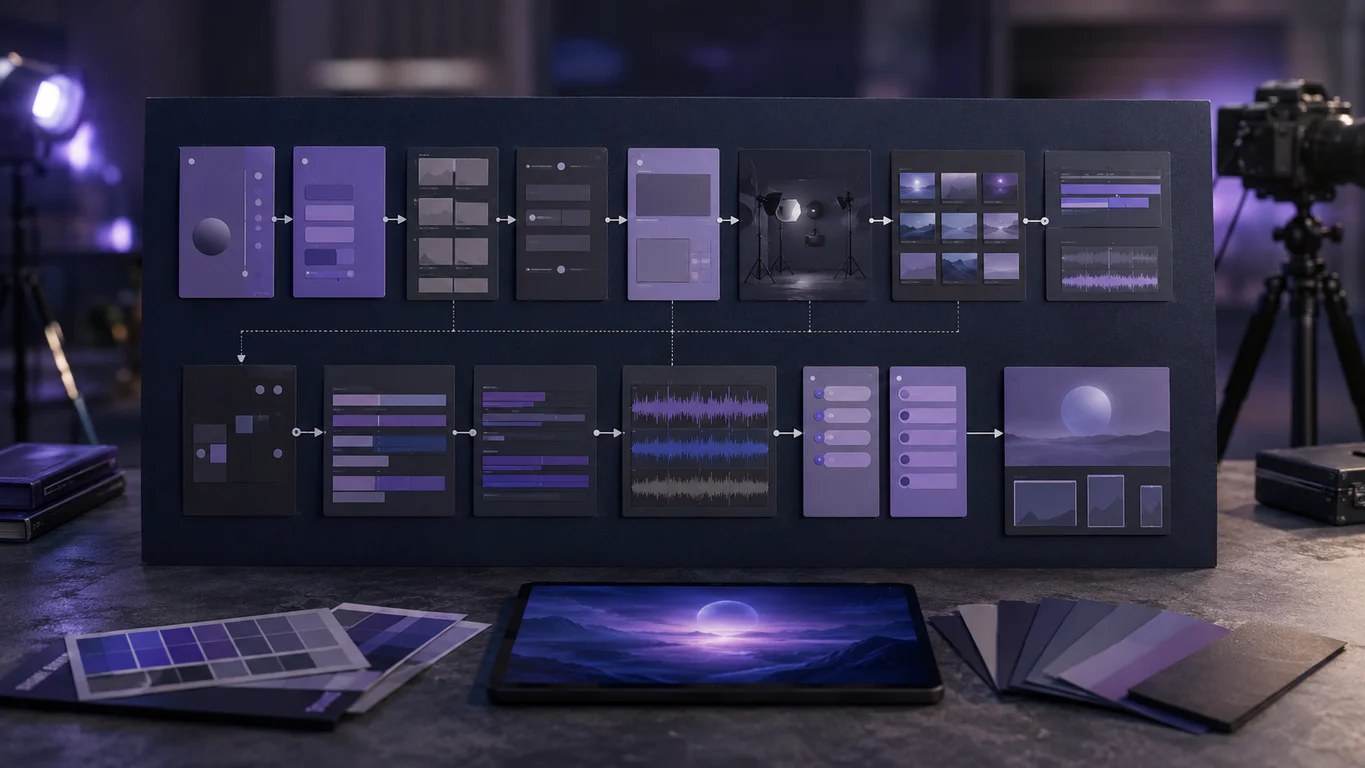
Video transcript
A company needs a profile video It orders one film, sends it everywhere The film fits nowhere fully The money is spent. Nobody served. Here is how to avoid that Part one The problem A profile video is not one format It is not a single format
It works in three runtime tiers Runtime means how long it runs Each tier serves a different audience Match the length to the room 60 to 90 seconds: front of a tender A tender: documents to win a contract 2 to 3 minutes: meeting or launch 4 to 6 minutes: buying, hiring, training Procurement, recruitment, training
Part two The answer Length is not a free choice Under 60s reads like a social ad Over 6 min: attention drops sharply Match the runtime to the room The short film has a fixed shape Six beats, in order Hook, problem, who you are
How you solve it, one result And finally, the next step The shape sets a word budget 90 seconds: about 190 to 225 words 280 words will overrun Tight scripts keep the film calm Part three The takeaway
Plan the languages early Bilingual: a film in two languages It is a second script and voice record About 1.6 to 1.8 times the base cost Decide three things at the brief stage The tier, audience, and languages A good profile video lasts 2 to 3 years Choosing early beats fixing later
A company profile video in 2026 is no longer a five-minute corporate film with a logo opener and a chairman talking head. The format has split into three working runtimes: a 60 to 90-second brand film that runs at the front of a tender pack or a website hero, a 2 to 3-minute corporate film for AGM playback and launch events, and a 4 to 6-minute extended cut for procurement, recruitment, or training contexts where the audience is captive.
Three formats, one brand. The mistake most Malaysian briefs make is commissioning one film for all three. The result drags at AGM, runs too long on LinkedIn, and lands at half-effectiveness in front of a procurement panel that needs 90 seconds and a clear answer.
Corporate video, motion graphics, and brand film work make up a core part of what an in-house team of 40 specialists at Walk Production has produced since 2018. The team is based in Kuala Lumpur and Selangor, serving SMEs, GLCs, Bursa-listed companies, and federal agencies across Malaysia, Singapore, and the wider Asia-Pacific region. The format mix, runtime tiers, regulatory frame, RM cost bands, and case studies below come from that same quarterly body of work.
For the wider corporate video production framework that sits above this anchor, see corporate video production in Malaysia. For the printed and PDF company profile sister product, see company profile design in Malaysia. For the tender procurement layer where a company profile video may support the bid (subject to what the tender notice permits), see our ePerolehan tender guide and JKR tender guide.
What a company profile video is for
A company profile video is a credibility document in motion. It does the same job the printed company profile does (introduce the company, establish capability, name proof points, point to a next step) in the time the viewer will give it. The audience is rarely a casual browser. It is a procurement evaluator inside a 90-minute review window, an IR director scanning pitches, a senior recruit deciding whether the offer letter is worth signing, or a partner-development lead picking which of three shortlisted suppliers to call back.
Four working uses come up most often in our agency experience, each shifting the pacing and the tone of the cut.
Business-development asset. Attached to a follow-up after a meeting, or embedded on the homepage where a partner introduction lands. The reader is a buyer evaluating credibility. Runtime: 60 to 90 seconds. Tone: confident, factual, low on adjectives.
Tender and procurement support. The film a bidder uses around a Malaysian tender: as a supporting presentation at the post-tender clarification meeting, at a technical-pitch session, at the partner-introduction meeting that precedes a tender, or in BD follow-up. Inside the formal submission pack only where the published tender notice explicitly permits a video file as an inclusion. Runtime: 60 to 90 seconds. Tone: operational, low-narrative, structured to mirror the published rubric.
Investor and stakeholder communication. The film that opens an AGM, sits at the front of a Bursa-listed company’s IR microsite, or plays at an institutional roadshow. Runtime: 2 to 3 minutes for AGM playback; 60 to 90 seconds for the IR microsite hero loop. Tone: governance-aware, factual, structured to anchor the chair’s commentary rather than upstage it.
Recruitment and employer brand. The film a candidate sees on the careers page before deciding to apply, or that runs at a senior-hire offer-stage meeting. Runtime: 90 to 120 seconds. Tone: warmer, faces of real staff, ambient sound from the floor, less voice-over and more on-camera lines from people doing the work.
The same brand identity carries across all four uses. What changes is the runtime, the structure, the proof beats, and the closing call to action. A client running all four uses simultaneously typically commissions one production block that yields a flagship cut and three derivative cuts.
Company profile video versus corporate film versus brand film
Buyers conflate these formats often. They are not the same product, and treating a company profile video brief as if it were a brand-film brief tends to produce a deliverable that does neither job well.
| Format | Primary job | Runtime | Lifespan |
|---|---|---|---|
| Company profile video | Capability and credibility for BD, tender, IR, recruitment | 60 to 90 seconds (60s flagship) / 2 to 3 minutes (AGM and event) | 2 to 3 years before major refresh |
| Brand film | Identity and positioning, longer-form storytelling | 60 to 180 seconds | Single campaign window, refreshed annually |
| Explainer | One product, one process, one policy | 60 to 90 seconds | Until the product or policy changes |
| Corporate film (full-length) | Full narrative for AGM, IR day, anniversary moment | 3 to 6 minutes | 2 to 3 years; usually refreshed alongside the annual report cycle |
| Event recap or montage | One event, retold for promotion and recruitment | 60 to 180 seconds | 6 to 12 months |
| Testimonial film | Customer voice, late-stage trust signal | 60 to 120 seconds per subject | 12 to 24 months |
A brand film is a positioning piece. It works once, sits at the heart of a campaign, and gets retired when the campaign ends. A company profile video is a longer-lived credentials document; it earns its place on the homepage hero, in the tender appendix, and at the front of the AGM pack across multiple cycles. An explainer is narrower still, built around a single idea. Each format calls for a different script structure, a different shoot list, and a different post-production rhythm.
For the full nine-format mix across corporate video work (corporate profile, brand film, explainer, motion graphics, product, testimonial, event, training, social), see our corporate video production guide. The discipline that pays off the most is naming the format mix in week one of the brief, before the kit is booked against a single-format quote.
Three working runtime tiers
Three runtime tiers cover most Malaysian company profile video briefs. The pricing tiers in the cost section below map to these runtime tiers, but the runtime decision is upstream of the cost decision: pick the runtime against where the cut runs and who watches it.
Below 60 seconds, the format starts to read as a social ad rather than a credentials document. Above 6 minutes, attention drops sharply outside specific captive contexts (training rooms, AGM halls). For a Bursa-listed company commissioning a film alongside its annual report cycle, the working pattern is one flagship 2 to 3-minute cut for the AGM, a 60 to 90-second cut for the IR microsite hero, and a 30 to 45-second cut for LinkedIn or the IR microsite news feed. Three deliverables, one shoot. Formal Bursa LINK disclosures remain documentary and separate from the video assets.
The 90-second script structure
The 90-second runtime is the workhorse. Seven beats hold the structure together, and the structure carries up to the 2 to 3-minute tier with two extra proof beats inserted in the middle.
- 0 to 5 seconds, visual hook. Open on the operating reality, not the logo. A control room screen, a cargo bay door rolling up, an auditor flipping a report, a graduate stepping onto a working bridge. The first five seconds answer the implicit “can you actually do this” question before any voice-over starts.
- 5 to 15 seconds, audience problem in plain language. Name the thing the viewer is currently dealing with, in the words they would use. Not “compliance complexity”: “the auditor is on-site Thursday and the file is not ready”. Not “supply chain disruption”: “the consignment leaves Penang at 22:00 and the documents are still pending”.
- 15 to 30 seconds, who you are in one sentence. Company name appears here for the first time. What you do, who you do it for, one differentiator. No founding-year, no tagline, no values pillar list.
- 30 to 50 seconds, how you solve it. One or two concrete operating beats, shown on camera. Show the operation, the equipment, the team mid-task. No voice-over claim you cannot show on camera.
- 50 to 70 seconds, a named outcome or named client. A figure, a route, a milestone, or a client logo you have permission to use. Specifics over adjectives. “Two hundred consignments overnight from Penang to Hong Kong” lands harder than “extensive cargo network”.
- 70 to 85 seconds, where you operate, scale signal. A map graphic, a footprint shot, or a single voice-over line on geography or capacity.
- 85 to 90 seconds, clear call to action with a URL. One action, one URL. Hold the lock-up for the full five seconds so a viewer on a silent feed can read it.
Word-count discipline at 90 seconds is roughly 190 to 225 words of voice-over at 125 to 150 words per minute. Always count words and add time for visual-only moments and transitions. A 90-second script that comes in at 280 words will overrun, and the editor will cut the visual hook before the voice-over to make it fit, which collapses the structure.
For the longer 2 to 3-minute tier, two extra beats sit between “how you solve it” and “a named outcome”. Add a second proof beat for an industry-specific operation, and a third proof beat for a scale or certification signal. The structural rule is the same: one idea per cut, one ask at the end.
Distribution cuts and platform aspect ratios
A company profile video that lives on one platform is rare. The same shoot day typically yields three aspect ratios, sometimes four. Plan the aspect-ratio mix at brief stage.
- 16:9 horizontal. The master format. Serves the website hero, the YouTube channel, the AGM screen, the conference room display, and the tender pack PDF embed. Composes for full-frame viewing on a desktop or a projector.
- 9:16 vertical. Serves Instagram Reels, TikTok, LinkedIn mobile feeds, and WhatsApp Business profile videos. Composes for handheld sound-off viewing with the subject centred in the top two-thirds of the frame.
- 1:1 square. Serves in-feed Facebook and Instagram, LinkedIn desktop, and digital out-of-home placements (lift lobbies, mall screens, MRT platforms) where the available real estate is square rather than landscape.
- 4:5 portrait (optional fourth). Serves Instagram in-feed posts at maximum vertical real estate, useful where the brand publishes heavily on Instagram and treats Reels as a separate format.
A shoot designed around three aspect ratios costs roughly 15 to 25 per cent more than a single 16:9 shoot, because the DOP frames the action with a safe-area overlay covering all three crops and the editor cuts each version from picture lock onwards. A shoot that retrofits 9:16 and 1:1 from a 16:9 master in post costs roughly 30 to 50 per cent of base in extra edit time and almost always loses framing on the vertical cut. The cheaper option at brief stage is the more expensive option at delivery.
Two technical specifications matter for distribution. Resolution: shoot 6K, deliver 4K UHD as the archival master and 1080p for web and social, which buys you reframing room in post and futureproofs the masters for a re-cut two or three years out. Frame rate: 25fps for Malaysian broadcast-aligned work, 24fps for cinematic delivery, 30fps for social-led work; mixing frame rates inside a single export creates artefacts that show on a high-refresh screen.
Bilingual and multilingual treatment
For a Malaysian listed company, GLC, federal-agency supplier, or any operator with a substantial Bahasa Malaysia-speaking audience, bilingual treatment goes from optional to standard. Two working approaches cover most briefs.
Single master with subtitle layers. The voice-over runs in one language; the second language sits as a burned-in or sidecar subtitle pass. Lower cost, suitable for sound-off social feeds and contexts where the viewer can choose the subtitle layer. English voice-over with a Bahasa Malaysia subtitle pass is the most common Walk Production pattern for client-facing social and web cuts.
Two parallel voice-over masters. Two separate voice-over recordings, two separate subtitle passes, two separate exports. Higher cost, suitable for AGM playback (where a Bahasa Malaysia voice-over reads as more respectful to a federal or statutory audience than a subtitle), stakeholder meetings, and IR microsites with language-aware landing.
The bilingual uplift is broadly 1.6 to 1.8 times the single-language base once translation, voice-over recording, BM editorial review, subtitle pacing, and a second review cycle are added. In the scripts we record, Bahasa Malaysia voice-over text typically runs 15 to 25 per cent longer than the English equivalent, which means the script has to be written short enough on the English side that the BM voice-over still fits the timeline.
For trilingual treatment (English, Bahasa Malaysia, and Mandarin or Tamil), the uplift sits closer to 2.2 to 2.5 times the single-language base. Trilingual is most common for Klang Valley and Penang B2B audiences (English and Mandarin), hospitality and tourism brands targeting Chinese-speaking inbound markets, and federal agencies addressing multi-ethnic constituencies. Trilingual production discipline is different: typesetting rules for Chinese characters, character spacing in subtitles, and the trilingual grid each carry their own rules.
For the editorial discipline above the bilingual layer (translation, BM editorial review, parallel-grid layout), see our bilingual copywriting guide. For the printed and PDF company profile sister product where bilingual treatment is also standard, see company profile design in Malaysia.
Tender, investor, and recruitment use cases
Three high-stakes use cases drive most Malaysian company profile video commissions. Each shifts the script, runtime, and production discipline.
Tender and procurement support
A company profile video can only be included inside a Malaysian tender submission pack where the published tender notice explicitly permits a video file as an inclusion. Where the notice does not name video, keep the film out of the formal submission. The tender notice controls submission method, accepted file format, maximum file size, document inclusions, and the platform-specific upload route on ePerolehan or Sistem JET. Late or non-compliant submission may be rejected on the terms of the notice.
Where the notice does not allow a video file inside the pack, the company profile video still earns its place as a supporting asset outside the formal submission: at the post-tender clarification meeting, at the technical-pitch session if one is called, at the partner-introduction meeting that precedes a tender, or in BD follow-up after submission. The film supports reader or reviewer navigation in those contexts; it does not substitute for a strong technical answer and does not determine how the panel scores any specific rubric item.
For the wider procurement framing, see our tender process in Malaysia guide and tender proposal design guide.
Investor relations and Bursa-listed company use
A Bursa-listed company commissioning an IR video typically runs three deliverables from one shoot: a 60 to 90-second hero loop for the IR microsite homepage, a 2 to 3-minute AGM playback cut, and a 30 to 45-second LinkedIn cut or IR microsite clip for owned-channel distribution. The AGM playback anchors the chair’s commentary; the IR microsite cut sits on the homepage hero alongside the annual report PDF download.
For listed companies, the disclosure layer matters. Formal Bursa disclosures remain in Bursa LINK and are not replaced by a video; the IR film is a communications asset that must align with the material information already disclosed through Bursa LINK, the annual report, and the sustainability statement. An IR video containing a forward-looking statement, a financial figure, or any other material information not first disclosed through the formal filings is a disclosure problem for the issuer. The Bursa Main Market Listing Requirements set the disclosure perimeter; the film sits inside it. For the wider annual report cycle that the IR video accompanies, see annual report types and costs in Malaysia.
Recruitment and senior-hire employer brand
A recruitment company profile video is a different brief from a BD or IR film. The audience is curious and emotional, picturing themselves at the desk. The film leads with real-staff faces, ambient sound from the floor, and on-camera lines from people doing the work, and keeps the CEO talking head out. Runtime sits at 90 to 120 seconds because the candidate watches it more than once, often after the offer lands. The film closes on a culture signal and leaves the commercial call to action to other cuts.
Two working sub-formats: a general careers-page hero loop, and a senior-hire offer-stage briefing film. The first is broad and aspirational; the second is role-specific, with the team the hire would join visible on camera. Both come out of the same shoot if planned at brief stage, with the senior-hire variant cut later from the same library plus one named-team interview.
The Malaysian regulatory frame for company profile video
Four regulatory and licensing layers shape any serious company profile video brief in Malaysia. The layers do different work, and conflating them is one of the more common compliance mistakes we see in Malaysian briefs.
FINAS for film and video production licensing. The National Film Development Corporation Malaysia regulates film and video production, distribution, and exhibition under the Finas Act 1981. Licensing scope and exemptions for corporate, advertising, and online-only video work change over time. The practical rule is to confirm current FINAS requirements at the brief stage with your production partner rather than assume an industry default.
CAAM for commercial drone operations. The Civil Aviation Authority of Malaysia regulates commercial Unmanned Aircraft Systems work. Commercial drone use typically requires operator registration and an Unmanned Aircraft System Activity Permit, with restricted-airspace zones carrying additional restrictions. Per CAAM’s current UAS guidance, applications should be submitted at least 14 working days before the activity, longer for restricted airspace or temporary processing windows. For a corporate profile film with a facility aerial shot, build the 14 working days into the schedule from week one of pre-production.
Broadcast and content-code clearance for paid-media use. A company profile film that stays on owned channels (website, LinkedIn page, YouTube channel, AGM hall) generally sits outside the Lembaga Penapis Filem (LPF) film censorship regime under the Ministry of Home Affairs. A cut that moves to paid Malaysian broadcast or public exhibition may require broadcaster review, LPF censorship approval, publicity material censorship, and review against the MCMC Content Code under the Communications and Multimedia Act 1998. The Malaysian Communications and Multimedia Commission sits across content standards and licensed communications and broadcasting, rather than as a single film-clearance body. Confirm the specific clearance chain with your production partner at the brief stage.
PDPA 2010 as amended by Act A1727 (2024) for talent and customer footage. Any on-camera footage of identifiable individuals (employees, customers, hired talent, senior hires) is personal data under the Department of Personal Data Protection (JPDP) framework. The release should cover usage scope, distribution duration, retention period, the right to withdraw consent, and the data-handling chain after production wraps.
A fifth layer covers music. Music used in a published Malaysian company profile film sits inside three Malaysian collective management organisations: MACP for composers, authors, and publishers; PPM for recording producers; and RPM for recording performers. Library tracks (Epidemic Sound, Artlist, MusicBed and similar) carry per-platform licensing terms that vary by usage scope; confirm the licence covers paid distribution as well as organic posting.
Sector regulators stack on top where relevant. Bank Negara Malaysia for banking, insurance, and takaful promotion; the Securities Commission Malaysia for capital-market products, investment promotion, and finfluencer guidance; the Ministry of Health and its Medicine Advertisements Board for registered medicines, healthcare facilities, and prohibited medical claims under the KKLIU framework; JAKIM considerations for halal-positioned visual choices.
RM cost bands for company profile video
Three working tiers cover most Malaysian company profile video briefs. The bands below are Walk Production’s quoting framework specifically for company profile video, sitting inside the wider corporate video cost frame in our corporate video production guide. The bands are not an industry rate card; smaller agencies and freelancers price differently.
Below RM 8,000 is possible but normally produces a single-day reduced-crew shoot closer to a social cut than a corporate profile film. Above RM 80,000 is also possible, but it usually shifts the brief from a profile video to a brand campaign, with celebrity ambassadors, international location work, or a multi-quarter media plan attached.
The hidden costs Malaysians often miss sit on top of the base band. Talent buy-out for non-celebrity on-camera talent runs RM 3,500 to RM 5,500 for a 12-month Malaysia domestic release; celebrity talent and overseas territories run higher. Music licensing for a paid-distribution cut runs into the five figures for recognisable commercial tracks; custom composition for a flagship sits at RM 6,000 to RM 18,000. CAAM drone permits cost less than the schedule drift caused by submitting late. Broadcast clearance lead time is real where the cut moves to paid TV. Bilingual subtitle pass and second-language voice-over recording add time on the timeline and a separate review cycle with the client.
For the day-rate maths underneath these tiers (director, DOP, gaffer, sound recordist, kit hire, drone pilot, location fees), see the cost section in our corporate video production guide.
Selected Walk Production company profile video work
Four projects from our video portfolio show how company profile video discipline translates into different Malaysian sectors. Each one ran across a different audience, format mix, and operating constraint, and each one started from a brand identity that had to be translated into a video system before any camera turned on.
1. MSIG Insurance: festive motion graphic video series
MSIG Insurance (Malaysia) Berhad is a general insurance provider based in Malaysia. The brief sits adjacent to a classic company profile video brief: a festive motion graphic series delivering greetings across Hari Raya, Chinese New Year, Deepavali, and Christmas, anchored to MSIG’s brand identity rather than to generic seasonal stock. Walk Production handled art direction, custom illustration, storyboarding, motion graphic animation, and video editing. Each video began with a key visual establishing the cultural occasion while staying connected to MSIG’s brand identity, with distinct colour palettes, illustration styles, and visual motifs reflecting each celebration’s character and a recognisable MSIG thread maintained throughout. The pattern translates directly to company profile video work for insurance and financial services brands where seasonal content sits alongside the core profile film in the annual content plan.
2. Port Klang Cruise Terminal (PKCT): launch video with drone cinematography
Port Klang Cruise Terminal (PKCT) is a maritime facility providing cruise passenger services and port operations. The launch film functioned as the terminal’s company profile video for both B2B (cruise operators, tourism partners) and public-facing (travelling cruise passengers) audiences. Walk Production managed storyboard and scriptwriting through filming, motion graphics, and final delivery, with full project management across stakeholders. The storyboard was built around a guest-centric narrative following the passenger journey from arrival to departure. Aerial drone cinematography captured the scale of the facility; ground-level footage covered check-in, cultural exhibitions, and food service areas. The launch asset introduces the terminal from a single cut, supporting both operator credibility and visitor-facing tourism appeal.
3. Malaysia Convention & Exhibition Bureau (MyCEB): MyTripleE 2.0 programme montage
Malaysia Convention & Exhibition Bureau (MyCEB) is a government agency responsible for promoting Malaysia as a destination for international business events. The MyTripleE 2.0 programme sits within the broader “Meet in Malaysia” campaign. The brief functioned as a federal-agency company profile montage tied to the campaign identity, distilling the programme’s three pillars and event highlights into a promotional piece. Walk Production provided art direction, key visual design, scriptwriting, motion graphics, and video editing. The key visual was designed as a brand anchor across video, print, and digital, extending the production’s value beyond a single-use asset. Short rhythmic script lines synchronised to specific visual sequences rather than carrying heavy exposition; motion graphic elements transitioned between event-footage segments and reinforced key messages through animated typography.
4. Raya Airways: multi-format video series across corporate and social
Raya Airways is a cargo airline providing freight and charter services across regional aviation routes. The brief is the textbook multi-format company profile video commission: a longer corporate cut for stakeholder presentations and brand events, plus condensed social cuts formatted for digital distribution. Walk Production handled content planning, scriptwriting, filming, editing, motion graphics, voice-over delivery, and project management. On-location filming captured the scale of cargo operations (aircraft on the tarmac, cargo handling, crew at work), with cinematography balancing documentary-style operational footage against brand sequences that lifted the visual quality for the corporate cut. Motion graphic elements carried route maps, capacity figures, and regional reach without forcing the voice-over to recite numbers. Longer-form corporate versions serve stakeholder presentations and events; condensed social cuts are formatted for digital distribution.
The pattern across the four is consistent. Brand identity sets the structure. The runtime tier is picked against the audience the cut serves. The aspect-ratio mix is planned at brief stage so one shoot day yields the deliverables the channel mix needs. Motion graphics carry data without forcing the voice-over to do work the visual layer should be doing.
Common company profile video mistakes
Six mistakes show up across most of the second-round conversations we have with Malaysian companies commissioning a profile video. Each one is recoverable, but each one is more expensive than the discipline that would have prevented it.
Commissioning one film and trying to use it for four audiences. The same script and runtime cannot serve a 90-second tender-support presentation film, a 3-minute AGM playback, a 9:16 LinkedIn cut, and a recruitment careers-page hero loop. Plan the deliverable mix at brief stage; cut the masters from a single shoot day where the formats are compatible, and accept two shoots where they are not.
Opening on the CEO talking head. A CEO opener dates fast, opens slow, and wastes the only seconds in the film the procurement panel or the investor will give it cold. Open on the operating reality instead. Bring the leader in only if they have one sentence worth saying on camera, and place that line at the 60 or 70-second mark, after the audience cares about who is speaking.
Briefing without specifying the aspect-ratio mix. A 16:9 shoot that gets retrofitted to 9:16 in post loses framing on every cut. The DOP needs the aspect-ratio mix at framing stage so the action sits inside the safe area for every output ratio. Decide the mix at brief stage; budget the 15 to 25 per cent uplift for a multi-ratio shoot rather than the 30 to 50 per cent post penalty for retrofitting.
Underestimating bilingual treatment. Bilingual is not a post-production afterthought. It changes the script (because voice-over lines have to carry meaning when read silently in caption form), the runtime (because Bahasa Malaysia voice-over text runs 15 to 25 per cent longer than English on our own productions), and the review cycle (because the BM cut needs its own approval round). Confirm the bilingual question at brief stage, against the actual audience mix.
Skipping permit lead time on CAAM drone work. A facility aerial shot scheduled for a Wednesday with the permit submitted the prior Monday has already missed the permit window. CAAM applications should be submitted at least 14 working days before the activity, longer for restricted airspace. Build the lead time into the schedule from week one of pre-production.
Ignoring distribution requirements at brief stage. A 16:9 master with a centre-frame composition does not crop cleanly to 1:1 or 9:16 without losing half the frame. Plan the distribution channel mix at brief stage and shoot with vertical and square reframes in mind. Retrofitting platform cuts after master lock costs roughly 30 to 50 per cent of base in extra edit time.
A seventh, related mistake: confusing the company profile video with the brand film. A brand film is a campaign-window positioning piece; a company profile video is a longer-lived credentials document that earns its place across BD, tender, IR, and recruitment uses for two to three years. Brief the format you need.
Where to start
If you have a tender deadline, an AGM in three months, a recruitment campaign launching, or a refreshed company profile design landing alongside, start a conversation with our team. Bring the audience mix, the channel mix, the runtime tier you have in mind, and the deadline. We will come back with a tier recommendation, a shoot window, and a draft deliverable list cut against the three aspect-ratio mix that fits your channels.
For the wider corporate video production framework, see our corporate video production guide. For the printed and PDF company profile sister product, see company profile design in Malaysia. For the IR and annual report cycle that listed-company profile videos often accompany, see annual report design in Malaysia. For the brand identity layer underneath every video frame, see brand identity and tone of voice for Malaysian companies.
Browse the video portfolio for adjacent work across insurance, maritime, government MICE, aviation cargo, hospitality, education, and industrial. For the service-page deliverable map, see corporate video production services and video editing services.