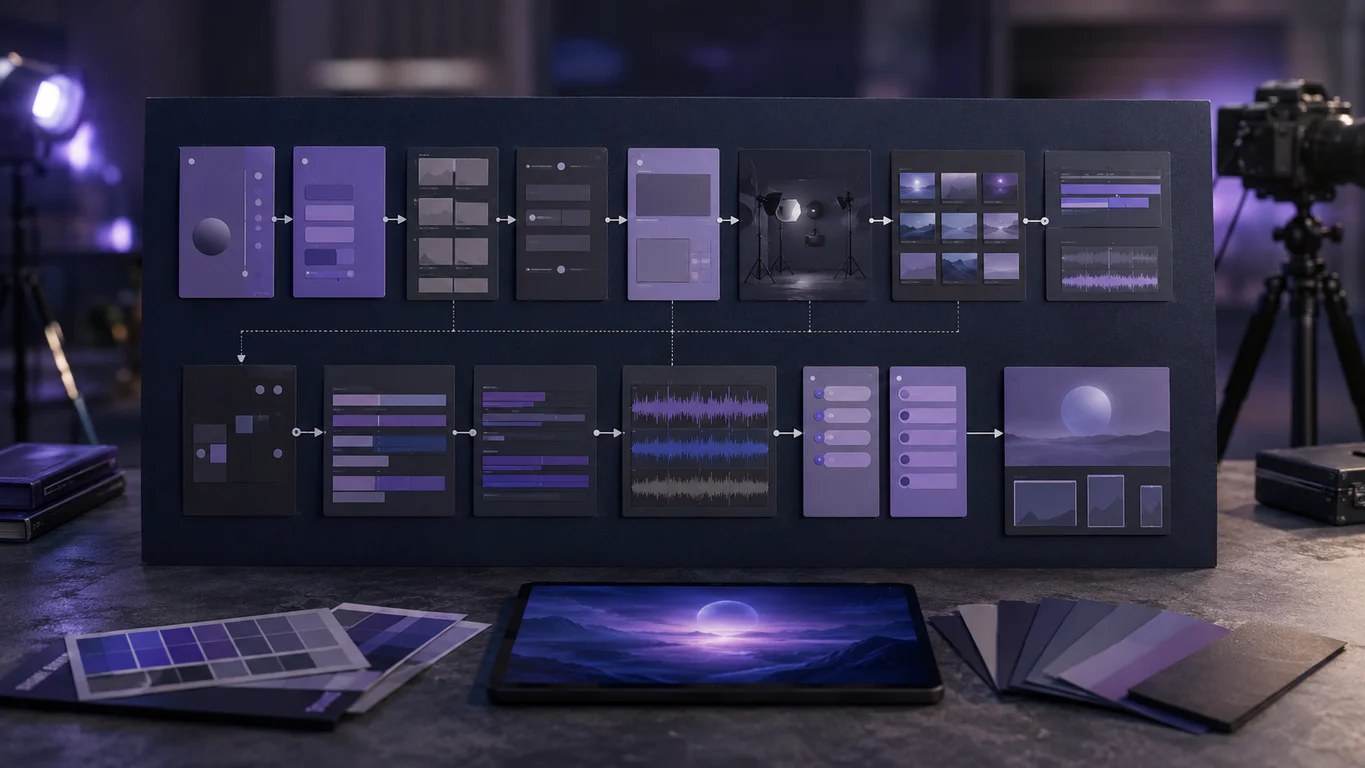
Video transcript
Video moves faster than any format A new platform rises, a format trends Suddenly the plan feels out of date So brands chase the trend Part one The problem Why chasing trends wastes the money Chasing trends scatters the budget Money chases the loudest noise
Nothing gets steady investment So nothing actually works The audience is not the problem 35.4 million internet users in Malaysia Almost everyone is online The problem is how money is split Part two The answer
Split the budget by a fixed rule Plan around a budget, not platforms The split: 40, 35, 15, 10 40% goes to anchor pieces Brand film, explainer, customer story 35% goes to short video Steady stream between big pieces 15% goes to paid distribution
Free reach is now unreliable 10% goes to production infrastructure Templates, motion libraries, caption styles Cut first, regretted most Short wins attention, long converts Part three The takeaway Hold the split steady all year
The plan is not the hot platform It is a fixed split 40 anchors, 35 short, 15 paid 10 infrastructure Hold the framework all year Video stops chasing trends It builds a library A library that compounds
The way an agency briefs a Malaysian video project in 2026 looks almost nothing like the way the same project was briefed in 2024. Two years ago, a corporate brief opened with a single 16:9 master cut for the website and the AGM; the vertical edit for social was an afterthought, cropped from the master after the client signed off. Today the vertical is drafted before the camera turns on, because the 9:16 cut is the version most viewers will actually watch. The shift sits inside almost every other change in the 2026 video market, from how scripts are written to how budgets are allocated to how AI is used in the pipeline.
A single hero film once counted as a year’s video strategy for many Malaysian brands. The system now running behind that shift belongs to Walk Production, an integrated creative agency in Kuala Lumpur and Selangor. Since 2018, our 40 in-house specialists have produced corporate video, motion graphics, and brand film work for SMEs, GLCs, Bursa-listed companies, and federal agencies across Malaysia, Singapore, and the wider Asia-Pacific region. The trend signals, format-by-audience patterns, RM budget framework, distribution mix, and case studies below come from work we run every quarter.
For the production framework underneath these trends (the three-phase process, the script structures, the six-stage edit pipeline, the regulatory layer), see corporate video production in Malaysia. For the company profile video format specifically (the 60 to 90-second piece for RFP covers, hiring pages, and conference loops), see company profile video guide. For the social media branding system that the short-form vertical cuts publish into, see social media branding and marketing in Malaysia. For the wider digital agency-selection layer above video, see digital marketing tools and agency selection in Malaysia.
The 2026 video landscape in Malaysia
DataReportal’s Digital 2026 Malaysia report puts the country at 35.4 million internet users, representing 98.0 per cent of the total population. Almost every adult buyer, hire, partner, and regulator a Malaysian brand needs to reach is online, and almost all of them are watching video. YouTube remains the dominant long-form platform in the country. Short-form vertical (TikTok, Instagram Reels, YouTube Shorts) carries most of the discovery layer for the under-35 segment. LinkedIn (around 10 million Malaysian members per LinkedIn Marketing Solutions and DataReportal) carries the B2B decision-maker layer. Facebook still holds the broadest reach for older skews and for federal and stakeholder audiences.
The audience numbers tell you the platforms are real. They do not tell you what to make. That second question is where most 2026 briefs go wrong, because the brand reads “video is up” and commissions one corporate film a year, then wonders why the feed is silent for ten months. The answer in 2026 is usually a system: one or two flagship anchor pieces, a continuous flow of always-on short-form, a discipline for cutting both from the same shoot day, and a paid distribution layer underneath.
Paid distribution on Meta, TikTok, YouTube, and LinkedIn now carries video formats that did not exist as standard ad units two years ago (Reels Ads, Shorts Ads, TikTok Spark Ads, LinkedIn Video Ads). The cost of producing video keeps falling for the volume layer because tooling has improved; the cost of flagship anchor pieces is steady because the discipline that makes them work has not changed. That spread is the budget reality the rest of this guide is built around.
Six trend signals shaping 2026 briefs
The useful read of the 2026 market is which briefs are landing on agency desks now that did not arrive in 2024. Six recurring signals show up across most of our pre-production conversations.
Signal one: vertical-first storyboarding. Two years ago, the vertical cut was a crop. In 2026, it is the source. The shift plays out across the multi-format briefs we now plan from the start, including the multi-channel reuse approach behind work like the MyCEB MyTripleE 2.0 montage where the key visual and motion graphic system were planned to extend across video, print, and digital from brief stage. Vertical-first changes how you frame talent, compose graphics, and place the brand mark. Cropping a horizontal master into vertical at the end of an edit tends to lose energy.
Signal two: BM-first scripting for SME, government, and East Coast and northern-state audiences. The English cut becomes a translation. We made this shift after running BM-first and English-first cuts of the same tourism film past the same audience: the BM-first version consistently drew the warmer response from East Coast and northern-state viewers, even when the English version read more polished. Treat that as agency experience rather than a published benchmark. For corporate, B2B, and Bursa-listed work, English usually still leads, but the BM cut is no longer an afterthought.
Signal three: AI in the pipeline, humans on the deliverable. AI is doing real work on captions, transcripts, reformatting, and storyboard previews. It is not yet doing real work on final talent, voice-over, or B-roll for premium brand work. Bursa-listed companies and GLCs are now writing this split into 2026 contracts: AI welcome in the pipeline, human sign-off mandatory on the deliverable.
Signal four: multilingual reels from a single shoot. MICE, hospitality, and retail clients now routinely expect three-language reel sets (BM, English, Mandarin) out of one shoot day. Tamil is added for FMCG and public-sector campaigns. The cost of an extra language pass at storyboard stage is a fraction of a re-shoot, and the language matrix gets locked in pre-production rather than after the master is signed off.
Signal five: B2B brands commissioning TikTok-native content. Two years ago, a logistics or industrial client asking for a TikTok-first asset was unusual. In the last twelve months it has become routine, and the brief usually arrives with a competitor reference list. The visual style is hand-held, captioned, often filmed from the plant floor or terminal, with the brand mark inside the frame rather than as a top-and-tail bumper.
Signal six: shoppable short-form for the categories that suit it. Beauty, FMCG, light electronics, fashion, and home-and-living can drive measurable units through TikTok Shop and Instagram Shopping. For B2B, capital goods, regulated finance, and considered-purchase healthcare, shoppable video is theatre. Shoppable is genuinely growing in retail Malaysia and genuinely overstated for the rest of the market. Pick the right side of the line and budget accordingly.
The format mix that actually wins by audience
The format dictates everything downstream, so it should be decided before the budget is approved. The brief that lands “we want a video” without naming the format produces a quote no agency can defend. A useful filter: write down the audience first, then the goal, then the format follows.
The table below is the working format-by-audience map we use on most Malaysian briefs in 2026. The format names are the same ones the production playbook uses; this table layers the audience and goal logic on top.
| Format | Best audience | Working goal | Typical runtime |
|---|---|---|---|
| Brand or capability film | Investors, board, AGM, hiring funnel top | Trust, recognition, decision pre-frame | 90 to 180 sec |
| Corporate profile video | RFP cover, procurement panel, conference loop | Credibility, qualification | 60 to 90 sec |
| Explainer video | Considered-purchase B2B, fintech, SaaS | Comprehension, qualified lead | 60 to 90 sec |
| Motion graphics for results and AGM | Bursa-listed shareholders, analysts | Disclosure clarity | 90 to 180 sec |
| Festive cultural piece | Retail, consumer, GLC, public sector | Goodwill, recall, share-of-voice | 30 to 60 sec |
| Product video (conversion) | E-commerce buyer on PDP or Shop | Add-to-cart, decision speed | 6 to 15 sec |
| Product video (catalogue) | Brand-page browser, range scanner | Range awareness | 30 to 60 sec |
| Testimonial video | Late-stage B2B, considered-purchase consumer | Stalled-deal unblocking, social proof | 60 to 120 sec |
| Event recap and montage | MICE delegates, sponsors, next-year promotion | Reach, recall, registration | 60 to 180 sec |
| Always-on social vertical | Discovery layer across TikTok, Reels, Shorts | Awareness, audience build | 6 to 45 sec |
| LinkedIn document carousel-with-video | B2B decision-maker scrolling on mobile | Authority, qualified inbound | 30 to 90 sec native |
| Training and onboarding | Internal staff, vendor partners | Compliance completion, knowledge transfer | 90 sec to 5 min |
The pattern worth reading in the table: the same brief almost never sits in only one row. A B2B fintech launch in 2026 might commission a 90-second explainer for the website hero, a 60-second cut for the founder’s LinkedIn feed, three 15-second vertical cuts for paid Meta and TikTok, and a 30-second conference loop for trade events. The right approach is a multi-format shoot day rather than five separate productions, which is the discipline the production framework in corporate video production in Malaysia covers in detail.
For the brand layer underneath every format choice (logo system, palette, typography, voice attributes, tone-by-channel), see brand identity and tone of voice for Malaysian companies. The format does the work; the identity layer underneath holds the format together across deliverables.
Platform mix: where each format lives
Format and platform are not the same decision. A 60-second explainer can run on the website hero, a YouTube Shorts feed, a LinkedIn native upload, a Facebook in-feed post, or a conference-room screen, and each placement changes what the cut needs to do in the first three seconds. The platform mix is where the format mix gets real.
A working Malaysian platform map for 2026 sits like this. The notes are our own editorial calls.
- TikTok. Discovery, intent, and culture. Vertical 9:16, captions on, hook in the first 1.5 seconds. Brand mark inside the frame. Sound-on assumption. Best for retail, F&B, hospitality, beauty, fashion, education, and any B2B brand willing to be more human in tone than its corporate site allows. For platform mechanics (TikTok Shop, Spark Ads, FYP discovery) and creator partnership tactics, see the TikTok marketing section of the social media branding playbook.
- Instagram Reels. Brand recall, lifestyle, aesthetic. Vertical 9:16, music-led, tighter aesthetic discipline than TikTok. Reels rewards a more polished cut, and Reels-native music and effects perform better than direct TikTok reposts.
- YouTube Shorts. Search-driven discovery. Vertical, up to 60 seconds, keyword-led titles, retention pacing. Shorts tends to bridge to longer YouTube watches when the long-form video on the same topic exists on the channel, subject to audience match and the prevailing platform algorithm.
- YouTube long-form. Consideration, trust, depth. Landscape 16:9, 90 seconds to 10 minutes, explainer or guest-journey narrative. The strongest single platform for considered-purchase research in Malaysia, particularly finance, property, education, healthcare, and B2B technology. Home for the flagship anchor films.
- LinkedIn native upload. B2B trust, executive authority, recruiting. Landscape or square, 60 to 120 seconds, named expert on camera, captions on, no over-music. Native uploads tend to reach more of the target audience than linked YouTube embeds, subject to LinkedIn’s prevailing distribution rules.
- Facebook native upload. Older audience, retargeting, federal and regulator-facing reach. Square or landscape, 30 to 90 seconds, captions on, slower pacing, clear call-to-action card at the end. Still the broadest reach in the country and the most reliable channel for reaching a Putrajaya audience.
- Bursa IR and corporate site. Annual report video, AGM playback, results recap, leadership address. Landscape, 90 seconds to 3 minutes, motion-graphics-heavy for figures, voice-over in English with BM subtitle, clean brand chrome. Earns its keep across investor day, AGM, the IR website, and the analyst LinkedIn post.
- WhatsApp Business and Telegram. Service video, onboarding, customer support, training, chatbot fallback. Vertical or square, under 60 seconds, captioned. The quietest channel and one of the higher completion-rate channels we track, because the audience opted in.
A single shoot can serve all of these. The Raya Airways video series is a clean example: on-location filming at the cargo facility produced longer-form corporate versions for stakeholder presentations and events, with condensed social media edits formatted for digital distribution. The shot list was built backwards from the cuts.
Short-form leads, long-form converts
Short-form video tends to hold attention better than longer formats on the briefs we run, and Wyzowl’s 2026 State of Video Marketing report finds that marketers continue to rate the 30-second to 2-minute range as the most reliable performer for engagement. In Malaysia specifically, the short-form vertical layer tends to outperform static posts on Meta and TikTok in our experience, with the gap widest in retail, F&B, beauty, and hospitality. Treat the comparison as agency experience; the actual gap depends on creative, audience match, and the prevailing platform algorithm.
Short-form is awareness. Long-form is where the buyer talks themselves into the decision. Webinars, explainer videos in the 3 to 5 minute range, and recorded case-study interviews are still the formats that move B2B procurement decisions. A short-form video gets you onto the consideration list. A long-form video gets you across the line.
Every short-form cut should point somewhere. A landing page, a long-form video, a contact form, a WhatsApp lead capture, an event registration page. If a 15-second TikTok or Reel is not connected to a next step, it produces brand impressions and little pipeline. Build the pathway at storyboard stage.
A working short-to-long pattern that fits most Malaysian B2B briefs:
- Discovery (15 to 45 seconds, vertical, paid plus organic). Two or three short-form cuts that name the audience problem in plain language and surface the brand. Distributed across TikTok, Reels, and YouTube Shorts. Goal: brand-aware audience and pixel-tagged retargeting pool.
- Consideration (60 to 90 seconds, square or landscape, paid retargeting). A mid-length cut that names the brand approach and shows one piece of proof. Distributed via Meta retargeting and LinkedIn Sponsored Content. Goal: site visit, lead-form view, video completion.
- Decision (3 to 8 minutes, landscape, owned channels and sales). A long-form anchor piece used in sales decks, on the website, and in nurture sequences. Distributed via owned email, sales hand-off, and YouTube long-form retargeting. Goal: meeting booked, RFP shortlist, signed contract.
Brands that skip the discovery layer get a beautiful flagship film that nobody finds. Brands that skip the long-form layer build an audience that never converts because there is nowhere for the curious viewer to go.
AI in production: where it earns its keep
AI tooling has moved into video production faster than any other change in the last 15 years. The honest read in our agency experience is that AI is doing real work in the middle of the pipeline and almost no real work at the ends.
Where AI is earning its keep on Walk Production briefs in 2026:
- Storyboard preview frames. Rough-image generation lets clients see a frame before crew is booked, which reduces mid-production rewrites. The frame is a directional reference only.
- Captions in three languages. AI handles the first pass; a human editor handles cultural and tonal corrections (the BM consonant clusters and Mandarin tone marks Malaysian audiences pick up instantly). Captioning that took a half-day now runs in 30 minutes plus a review pass.
- Reformatting one master into vertical, square, and landscape cuts. The boring, time-expensive work AI has genuinely eliminated. A human editor still reviews the auto-cropped frames for talent and brand-mark visibility.
- Transcript-tagging long interview footage. AI transcribes and tags hours of interview material so an editor can find soundbites in minutes rather than days. The single biggest time saver on testimonial and documentary work.
- Rough automatic colour matching across multi-camera shoots. A useful starting point for the colourist. Final grade is still human.
Where AI is not yet earning its keep on Bursa-listed, GLC, and premium brand work:
- Final talent. AI-generated humans still fail the Malaysian audience smell test for listed-company and GLC audiences where trust is the asset being built.
- Final voice-over for external brand films. AI BM voice still sounds slightly wrong, particularly on the consonant clusters Malaysian audiences read fast. We use AI voice for internal training and keep human voice-over for the masthead corporate film.
- Final B-roll. Lighting and physics tells disqualify AI-generated B-roll for premium brand work. Useful as moodboard reference only.
The split worth writing into a 2026 contract is which AI uses are allowed in the pipeline and which need human-final-deliverable sign-off. That document prevents the late-stage review meeting where the marketing director, the brand custodian, and the audit committee disagree about whether an AI-generated frame is acceptable in a published asset.
Multilingual reels and the BM-first decision
The language layer is where 2026 briefs increasingly diverge from 2024 briefs. Three patterns now repeat across most Malaysian engagements.
Multilingual reels from a single shoot. MICE, hospitality, retail, and consumer briefs routinely expect three-language reel sets (BM, English, Mandarin) out of one shoot day. Tamil is added for FMCG, public-sector, and selected community-facing campaigns. The cost of an extra language pass at storyboard stage is small compared with the cost of going back for a re-shoot. Our working brief now names the language mix on the same line as the platform mix.
BM-first for SME, government, and East Coast and northern-state audiences. The English cut becomes a translation. The shift came out of audience testing on tourism, federal-agency, and SME-targeted campaigns where the BM-first script tested measurably warmer with the target audience even when the English version read more polished. For corporate, B2B, and Bursa-listed work, English usually still leads, but the BM cut is built alongside the English one from the start.
English-first for B2B, finance, technology, and Bursa-listed work. English leads, BM runs alongside for the broader stakeholder audience, Mandarin captions are added for the Klang Valley and Penang B2B catchment where appropriate. Write the English short enough that the BM line still breaks cleanly on mobile, because BM subtitles tend to run 15 to 25 per cent longer than English equivalents on our own productions.
Lock the BM-first or English-first decision campaign by campaign. The call sits at the brief stage with the campaign owner, well before anyone reaches the voice-over booth. Getting this wrong is one of the most common pre-production failures we see, and the cheapest one to prevent.
Budget allocation: the 40/35/15/10 framework
If a Malaysian brand is working out where to put 2026 video spend, the split we recommend for a mid-sized brand sits like this. The numbers are a working starting point, and the section below covers how to flex them by sector.
The split flexes by sector.
B2B industrial, energy, and capital goods. Heavier on anchor pieces (50 to 55 per cent), lighter on short-form (20 to 25 per cent), 15 per cent on paid (largely LinkedIn Sponsored Content), 10 per cent on infrastructure. The decision-maker layer wants depth, and the always-on short-form layer is more about visibility for talent attraction and partner reach than direct lead generation.
Retail, F&B, hospitality, fashion, beauty. Lighter on anchor pieces (25 to 30 per cent), heavier on always-on short-form and shoppable content (45 to 50 per cent), 15 to 20 per cent on paid (Meta and TikTok), 10 per cent on infrastructure. Volume and recency matter more than flagship depth.
Bursa-listed corporate brands and GLCs. Heavier on flagship anchor pieces tied to the AGM and IR cycle (45 to 55 per cent), moderate short-form (15 to 20 per cent for executive thought leadership and employer brand), 15 to 20 per cent on paid (LinkedIn-led with selected Meta), 10 per cent on infrastructure. The annual rhythm is set by the financial year and AGM dates; build the plan backwards from there.
Education, NGOs, public sector. Variable by mandate. Education recruitment campaigns lean heavier on always-on short-form for Gen Z reach (40 to 50 per cent) plus parent-facing Facebook content (10 per cent), with a single annual hero piece (25 to 30 per cent). NGO and public-sector campaigns tend to over-invest in flagship pieces and under-invest in the always-on layer.
The 10 per cent line on production infrastructure is the one clients most often cut and most often regret cutting. Brand templates, caption styling, and a clean motion graphic library is what lets a small marketing team ship six pieces a month from one shoot day. Cutting the infrastructure spend in year one tends to cost more in year two, because every piece becomes a from-scratch production.
Distribution: organic, paid, and earned
A finished video is only half the work. The distribution mix decides whether the audience ever sees it. Three layers run in parallel.
Organic distribution. Owned channels: website, YouTube channel, LinkedIn page, Instagram and TikTok accounts, Facebook page, WhatsApp Business broadcast list, Telegram channel, email newsletter. Organic reach on Meta and LinkedIn is now lower than it was in 2022, and a flagship piece launched on organic alone tends to plateau quickly. Organic still does real work for brand-aware audiences, and a brand that publishes nothing organically reads as inactive even when it is running paid campaigns.
Paid distribution. Sponsored placements on Meta, TikTok, YouTube, LinkedIn, and X. Paid is where most flagship pieces actually find their audience in 2026; the planning question is no longer “should we put paid behind it” but “what percentage and which platforms”. For platform-by-platform paid mechanics (Meta Ads Manager, LinkedIn Sponsored Content, TikTok Spark Ads, YouTube Discovery Ads), see the pay-per-click practitioner guide. For the wider digital agency-selection layer, see digital marketing tools and agency selection.
Earned distribution. Press coverage, organic reshares, employee advocacy, influencer-led content, partner placements, search rankings on YouTube and Google for the long-form pieces. Earned is the slowest layer to build and the most defensible once it is working. For the content-marketing strategy underneath earned distribution, see the earned media and content marketing strategy guide.
A working balance for a mid-sized Malaysian brand: 60 per cent of distribution effort on organic publishing across owned channels, 30 per cent on paid amplification of the strongest pieces, 10 per cent on earned activities. The discipline of running all three layers in parallel rather than picking one is the consistent pattern in brands growing video reach in 2026.
Measurement: which numbers to read and which to ignore
Most Malaysian video reports show too many metrics and not enough decisions. The brands that read performance well track three layers and ignore the noise underneath.
The reach layer. Total impressions, reach, video views, view-through rate. Useful for budget allocation across platforms and for tracking whether the volume play is working. Not useful as the primary success metric for any individual piece, because impressions without engagement are noise.
The engagement layer. Average watch time, completion rate (especially on short-form vertical), click-through to the linked next step, comments and saves on Reels and TikTok, share rate. Healthy short-form completion runs at roughly half the audience or more for cuts that are working; notably weaker rates flag a hook that needs rework, subject to platform, audience, and the cut’s job.
The outcome layer. Lead-form submissions, qualified inbound DMs, sales-qualified meetings booked, brand search lift in Google Search Console, organic site visits attributed to video referrers, named-account lift on LinkedIn for B2B. The layer that ties video work to business outcomes, shown alongside the other two layers rather than as a footnote at the back of the deck.
Numbers that look impressive but rarely deserve weight in the report: total followers (vanity), organic Page reach on Facebook (low and unreliable), like counts on Instagram (decreasing platform signal), X impressions (highly variable). Those sit in an appendix; the main report runs on the three layers above.
Name the success metric per cut in writing before publication. A discovery cut answers “did we reach the target audience cheaply”. A consideration cut answers “did we move them along the funnel”. A long-form anchor piece answers “did it move the relationship”. Different cuts, different numbers, named at brief stage rather than measured retroactively.
The Malaysian regulatory frame for video distribution
Seven regulatory layers shape video distribution in Malaysia in 2026. Skipping them creates compliance risk and the kind of mid-flight campaign pull that wipes out a paid budget. The layers do different work; conflating them is one of the more common mistakes we see in 2026 briefs.
Online Safety Act 2025 and the MCMC platform layer. The Online Safety Act 2025, effective January 2026, sits with the Malaysian Communications and Multimedia Commission and applies to platforms and service providers (harmful-content systems, child-safety, user-reporting). Publicly named examples of platforms that have been treated as deemed-licensed under the related applications service provider class licensing framework include WhatsApp, Telegram, Facebook, Instagram, TikTok, and YouTube. The Act sits on top of the MCMC Content Code under the Communications and Multimedia Act 1998, which still governs content standards on licensed services. The Act and the Content Code are platform-and-service rules; brand-level disclosure rules sit elsewhere.
Sponsored-post disclosure (ASA Malaysia and CPA 1999). Influencer-led video content, paid partnerships, sponsored Reels, and brand-funded TikTok creator content require clear disclosure under the Advertising Standards Authority Malaysia code and the Consumer Protection Act 1999 framework administered by KPDN. Working disclosure conventions: #ad, #sponsored, the Paid Partnership tag on Instagram, the Branded Content tag on TikTok, a clear voice-over line in the cut itself (“a paid partnership with X”). Quiet sponsorship, where the creator does not disclose, is the practice that draws regulator attention and the most common failure point on brand-led influencer campaigns.
LHDN influencer income tax (2026 framework). Income earned by influencers and content creators from brand collaborations, paid partnerships, gifted product (cash equivalent), and sponsored content is taxable under the prevailing Income Tax Act framework. The Lembaga Hasil Dalam Negeri influencer guidance (LHDN) sets the working position that all influencer compensation, cash and non-cash, is taxable income. For brands commissioning influencer-led video, the practical implication is that gifted product, free travel, and value-in-kind compensation should be documented and itemised on the brief, and the influencer agreement should name the disclosure obligations on both sides.
PDPA 2010 (as amended by Act A1727) for video tracking and retargeting. Video distributed through pixel-tagged channels (Meta Pixel, LinkedIn Insight Tag, TikTok Pixel, YouTube remarketing) collects personal data on viewers. The Department of Personal Data Protection (JPDP) framework covers consent for tracking, retention duration, the right to withdraw consent, and the data-handling chain. The 2024 amendments via Act A1727 introduced breach notification obligations and sharpened the enforcement regime. Any retargeting strategy built on video viewers should reconcile against current PDPA practice and the published JPDP Pekeliling on data breach notification.
Ministry of Communications and FINAS for film and content production. The Ministry of Communications (Kementerian Komunikasi) sits across the broader communications portfolio, and the National Film Development Corporation Malaysia (FINAS) regulates film and video production, distribution, and exhibition under the Finas Act 1981. Licensing scope and exemptions for corporate, advertising, and online video work change over time and the public guidance is updated periodically. The practical rule for Malaysian brands is to confirm current FINAS requirements with the production partner at brief stage rather than assume an industry default.
Music licensing for video soundtracks. Licensed music engages three Malaysian collective management organisations: MACP for composers, authors, and publishers; PPM for recording producers; RPM for recording performers. Royalty-free libraries (Epidemic Sound, Artlist, MusicBed and similar) carry per-platform terms that vary by usage scope; confirm the licence covers paid distribution before locking the soundtrack. Sync rights for recognisable commercial tracks run into the five figures, and the licence chain for Malaysian-published music is best confirmed before publication.
Sector-specific rules layer on top. Bank Negara Malaysia for banking, insurance, and takaful promotion. The Securities Commission Malaysia for capital-market products, investment promotion, and finfluencer guidance. The Ministry of Health and its Medicine Advertisements Board for registered medicines, supplements, healthcare facilities, and the prohibited-claim list (the KKLIU framework). JAKIM considerations for halal-positioned brands. A capable agency builds clearance time into the campaign calendar from week one rather than treating it as an afterthought.
Selected Walk Production video work
Four Walk Production projects from our video portfolio show how the trends and budget framework above translate across different Malaysian sectors. Each one ran across a different format mix, audience, and operating constraint, and each one shows a different distribution pattern that fits the brief.
1. MSIG Insurance: festive motion graphic series
MSIG Insurance (Malaysia) Berhad is a general insurance provider based in Malaysia. The brief was a motion graphic series delivering greetings during key cultural celebrations. Walk Production handled art direction, custom illustration, storyboarding, motion graphic animation, and video editing. Each video opens with a key visual establishing the cultural occasion while staying connected to MSIG’s brand identity, with distinct colour palettes and motifs reflecting each celebration and a recognisable brand thread maintained across the set. Distribution was multi-platform social, each cut formatted for the platform. The pattern sits in the always-on social layer of the budget framework.
2. Port Klang Cruise Terminal: launch video with drone cinematography
Port Klang Cruise Terminal (PKCT) is a maritime facility providing cruise passenger services and port operations. The launch video had to thread B2B operator credibility with public-facing tourism appeal in a single cut, and that decision was made at brief stage rather than in the edit. Walk Production managed storyboard and scriptwriting through filming, motion graphics, and final delivery. The storyboard followed a guest-centric narrative from arrival to departure. Aerial drone cinematography captured the scale of the facility; ground-level footage covered check-in and visitor areas. The launch asset functions as a flagship anchor piece in the budget framework: one strong cut introducing the terminal to cruise operators, tourism partners, and the travelling public from a single source.
3. Malaysia Convention & Exhibition Bureau: MyTripleE 2.0 montage
Malaysia Convention & Exhibition Bureau (MyCEB) is a government agency responsible for promoting Malaysia as a destination for international business events. The MyTripleE 2.0 programme sits within the broader “Meet in Malaysia” campaign. The brief was a montage video distilling the programme’s three pillars and event highlights into a promotional piece tied to the campaign identity. Walk Production provided art direction, key visual design, scriptwriting, motion graphics, and video editing. The key visual was designed alongside the video so the asset extended across video, print, and digital. The brief is an example of the multi-channel reuse pattern: an asset designed once and deployed across video, conference loops, programme communications, and partner outreach.
4. Raya Airways: multi-format video series across corporate and social
Raya Airways is a cargo airline providing freight and charter services across regional aviation routes. The series was commissioned to strengthen brand presence and communicate operational capabilities to stakeholders and digital audiences. Walk Production handled content planning, scriptwriting, filming, editing, motion graphics, voice-over delivery, and project management. On-location filming balanced documentary-style operational footage (aircraft on the tarmac, cargo handling, crew activities) with brand sequences that lifted the visual quality for the corporate cuts. Motion graphics carried route maps, capacity figures, and regional reach without forcing voice-over to recite numbers. Longer-form corporate versions serve stakeholder presentations and events; condensed social media edits are formatted for digital distribution. The brief is a working example of the multi-format shoot day discipline: one production producing assets across the flagship and always-on layers from the same shoot.
The pattern across the four projects is consistent. The audience and the goal set the format choice. The distribution mix is planned at brief stage. Brand identity sets the structure underneath every frame, which the brand identity and tone of voice guide covers in detail.
Trends that are not actually trends (yet)
Six things that get pitched as trends and do not yet earn the budget.
Livestream commerce. Real in some categories (beauty, FMCG, light electronics, fashion), oversold in most. Average order RM50 to RM200 with a TikTok-daily audience is a genuine channel. Average order RM5,000 to procurement decision-makers researching across weeks rarely turns into pipeline.
Full AI-generated final spots. Not yet broadcast-ready for Bursa-listed and GLC audiences, and not ready for regulated finance, healthcare, and insurance. The gap between an AI-generated finalist cut and a human-produced finalist cut is still wide enough that audit committees flag it during review.
Interactive shoppable video on the corporate site. Useful for e-commerce. Mostly irrelevant for corporate, B2B, and Bursa-listed sites where the content’s job is trust and recall rather than a one-click purchase.
Pure influencer-led video as the brand strategy. Strong as a tactic inside a campaign. Weak as a substitute for owned brand video. Influencer reach is rented; owned video assets are bought.
AI-generated B-roll as a default content stream. Useful for moodboard and reference. Disqualified for premium brand work where the lighting and physics tells read as cheap to the audience.
Vertical-only content libraries. Some Malaysian brands have moved to publishing vertical only. The pattern works for retail and consumer brands whose audience lives on TikTok and Reels. It struggles for B2B brands whose decision-makers research on YouTube long-form and read LinkedIn on landscape monitors. Match the aspect ratios to the audience.
Common video marketing mistakes
Five mistakes show up repeatedly in the briefs that arrive at Walk Production for second-round work. Each one is recoverable, and each one is more expensive than the discipline that would have prevented it.
Over-investing in flagship pieces, under-investing in always-on short-form. A brand that commissions one beautiful 90-second film a year and nothing else gets a beautiful film and an empty feed. The 35 per cent of the budget framework on always-on short-form is what keeps the audience warm between flagship moments.
Cropping vertical from a 16:9 master at the end of the edit. The energy is gone, the talent is mis-framed, the lower-thirds are cut off. Vertical needs to be drafted at storyboard stage. Retrofitting platform cuts after master lock costs roughly 30 to 50 per cent of base in extra edit time.
Treating AI as a binary policy decision. “AI is allowed” or “AI is banned” both miss the actual call. The right policy names which AI uses are allowed in the pipeline (captions, transcripts, reformatting, storyboard previews) and which need human-final-deliverable sign-off (talent, voice-over, B-roll).
Skipping the distribution plan at brief stage. A finished video without a distribution plan plateaus inside two weeks. The paid layer should be planned alongside the production, before organic reach has a chance to disappoint.
Reporting on impressions rather than outcomes. The numbers that matter are completion rate on short-form, click-through to the linked next step, and qualified outcomes (lead-form submissions, meetings booked, brand search lift). Name the success metric per cut at brief stage rather than measuring retroactively.
A sixth, related mistake: under-budgeting the regulatory and clearance layer. ASA disclosure, LHDN influencer tax on gifted product, PDPA consent for pixel-tagged retargeting, music licensing across MACP, PPM, and RPM, sector regulators where applicable. Build the clearance windows into week one of pre-production.
Where to start: the 90-day action plan
Three concrete moves for the next 90 days if a Malaysian brand is rebuilding a video plan from where it currently sits.
Days 1 to 30: audit and decide. Audit existing video assets against the format-by-audience map and the platform mix above. Most brands we audit are over-invested in landscape and under-invested in vertical; the fix is usually a smarter re-edit. Decide the BM-first or English-first defaults per campaign rather than per company. Decide the AI policy in writing, naming pipeline-allowed uses and final-deliverable rules.
Days 31 to 60: plan the budget split and the calendar. Apply the 40/35/15/10 framework as a starting point and flex by sector. Map the 12-month calendar against the sector rhythm (AGM cycle for Bursa-listed, MOTAC seasons for hospitality, intake calendar for education, festive cultural moments for retail). Lock the flagship pieces against the calendar first, then plan the always-on cadence underneath.
Days 61 to 90: brief the first multi-format shoot day. Pick one shoot week that produces the flagship anchor piece, the consideration cut, and the always-on short-form layer from the same brief. Build the platform cuts into the storyboard at the start. Plan the paid distribution alongside the production rather than after. Lock the success metric per cut in writing before publication.
For the production framework underneath (the three-phase process, script structures, six-stage edit pipeline, regulatory layer in detail), see corporate video production in Malaysia. For the company profile video format, see company profile video guide. For the social media branding system underneath the short-form layer, see social media branding and marketing in Malaysia. For paid distribution mechanics, see the pay-per-click practitioner guide. For the earned-media and content marketing strategy underneath long-form anchor pieces, see the earned media and content marketing guide. Browse the video portfolio to see how the discipline translates across maritime, aviation, government MICE, and insurance.
Platform mix, budget allocation, language strategy, AI policy, and distribution decisions sit in the same room as the camera, the colour grade, and the copywriter at Walk Production, an integrated creative agency in Kuala Lumpur and Selangor. Since 2018, our 40 in-house specialists have planned, produced, edited, and distributed corporate video, motion graphics, social-first video, and brand film work for Malaysian listed companies, GLCs, SMEs, and federal agencies. To discuss a 2026 video plan, start a conversation with our team.